
TL;DR:
- Bass-driven dance music emphasizes low-frequency bass as the primary energy source rather than tempo. It has roots in marginalized communities and promotes inclusivity through safe spaces and diverse lineups. The genre relies on powerful sound systems and live audiovisual performances to create a physical and emotional experience.
Bass-driven dance music is an electronic music style defined by low-frequency bass as the primary melodic and rhythmic driver, not tempo. The genre is an umbrella term covering drum and bass, dubstep, halftime, breakbeats, and experimental bass hybrids. What separates it from other electronic styles is the emphasis on sub-bass and mid-bass as the main source of energy. The physical impact of those frequencies, felt in the chest and floor, is the point. THE GURLZ, a wifey DJ duo based out of Denver, CO, the bass capital of the world, build their entire live practice around this principle.
What is bass-driven dance music, and how does it work?
Bass-driven dance music centers on low-frequency bass as the primary energy source rather than speed or vocal hooks. Sub-bass and mid-bass frequencies carry the rhythm, the tension, and the release. Tempo matters, but it is secondary to how the bass moves.
The term “bass-forward mix” describes this approach in production. A bass-forward mix places the low-end front and center in the frequency spectrum, letting it drive the track’s momentum. Vocals, synths, and percussion support the bass rather than compete with it.
Bass-heavy music is engineered for high-fidelity sound systems that can reproduce frequencies below 100 Hz at volume. On a proper rig, those frequencies are not just heard. They are felt in the body. That physical sensation is what pulls people onto the dance floor and keeps them there.
What are the main bass music genres and their tempos?
Bass music genres each occupy a distinct tempo range and rhythmic feel. Understanding those differences helps you navigate the scene and know what to expect from a set.
| Genre | Typical BPM | Rhythmic feel | Key trait |
|---|---|---|---|
| Drum and Bass | 165–185 | Full-time, rolling | Complex breakbeats, fast energy |
| Halftime | 80–95 (felt) | Half-time, heavy | Slow groove, massive sub-bass |
| Dubstep | 140–150 | Half-time | Wobble bass, syncopated drops |
| Breakbeats | 110–140 | Syncopated | Chopped breaks, mid-bass punch |
| House | 120–130 | Four-on-the-floor | Groove-driven, bass-forward low end |
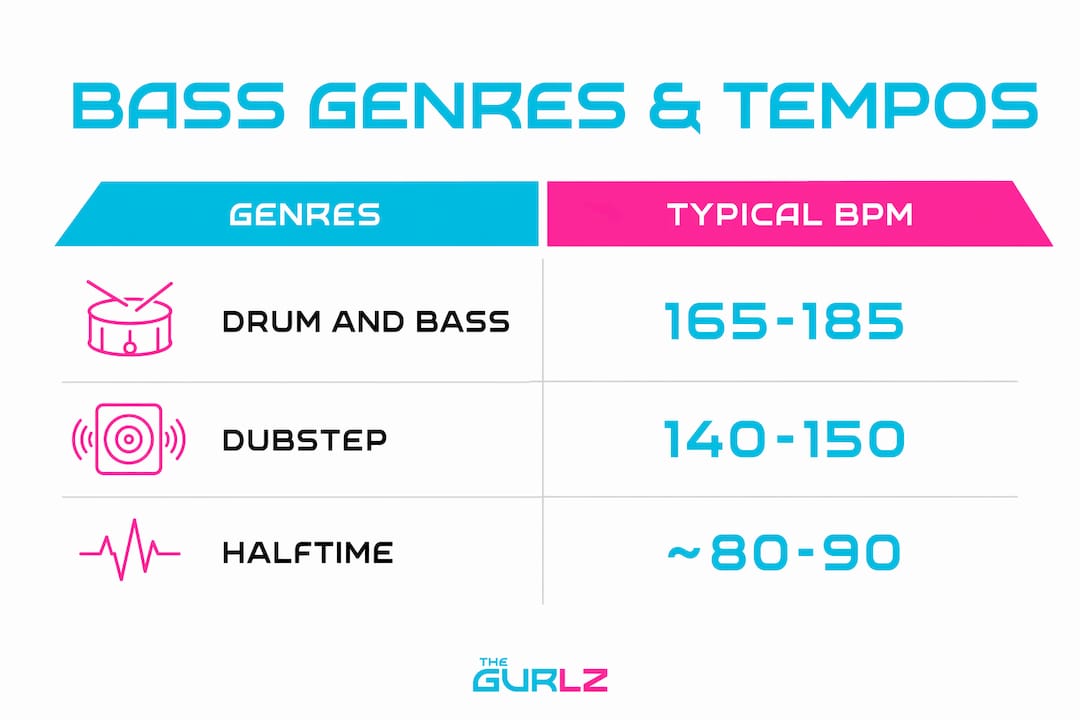
Drum and bass runs at 165–185 BPM with layered breakbeats that demand constant movement. That speed creates a specific kind of physical urgency on the dance floor. Dubstep operates around 140–150 BPM but uses a half-time rhythmic feel, meaning the body responds to a slower pulse even at a higher technical tempo.
Halftime is the most physically heavy of the group. The groove sits at roughly half the notated BPM, which creates space for enormous sub-bass tones to breathe. THE GURLZ move through all of these styles within a single set, reading the room and the location to decide what the moment needs.
Pro Tip: If you want to understand bass music tempos for dancers, pay attention to where the snare or clap lands. In halftime, it sits on beat three. In drum and bass, the snare fires fast and often. That placement tells your body how to move before your brain catches up.
How do producers engineer bass music for physical impact?
Bass music production is built around frequency management. The goal is a low end that hits hard, stays clean, and translates across systems from festival rigs to earbuds.
Sub-bass frequencies below 100 Hz are the foundation. They create the physical sensation audiences feel in their chest and feet. Producers design these tones with precision because too much energy in that range turns a mix muddy and undefined.
Side-chain compression is the standard technique for keeping the kick drum and bass from clashing. The compressor ducks the bass volume every time the kick fires, creating a pumping, punchy low end in the 20–120 Hz range. The result is a mix where both elements hit hard without canceling each other out.
Harmonic distortion and saturation solve a different problem. Sub-bass frequencies below 80 Hz are nearly inaudible on phones, laptops, and earbuds. Producers add harmonics in the 100–200 Hz range to give the bass presence on those devices. The listener may not feel the sub, but they still hear the weight.
Sound-design-led drops replace vocal choruses as the emotional climax in most bass music. A modulated bass tone, a reese bass, a wobble, or a layered sub swell carries the same emotional charge that a sung hook does in pop. That shift in structure is what makes bass music feel so different from other genres.
Pro Tip: Avoid boosting bass frequencies without first cutting the mud. Use a high-pass filter on every non-bass element to clear space below 200 Hz. A clean low end hits harder than a loud one.
What is inclusive bass music culture, and why does it matter?
Bass music’s cultural roots run through marginalized communities. Drum and bass grew from 1990s London pirate radio, where Black British, Caribbean, and working-class communities built a scene outside mainstream channels. Inclusivity is not a recent addition to bass culture. It is foundational.
“Bass music communities create queer safe spaces that bridge underground rave culture and genuine inclusivity. The scene’s origins in pirate radio and marginalized communities make representation a core value, not an afterthought.”
Grassroots collectives are now formalizing that value. Bass N Babes, an LA-based queer and femme collective, requires 100% women, queer, gender-fluid, or nonbinary artists in every show lineup. That policy extends beyond performers to production and event staff, including lighting, sound, and stage crew. The result is a safer environment for artists who have historically been excluded from technical roles.
The bass dance movement is expanding this further. Queer-led events and underground collectives are building spaces where the music and the crowd reflect the same values. The physical experience of bass music, bodies moving together in a shared frequency, makes those spaces feel different from standard club environments.
THE GURLZ are part of this shift. As a queer, married DJ duo, Desi and Angelina bring that lived experience into every set. Their work reflects what underground electronic music culture looks like when it centers the people who built it.
How is bass music experienced live, and who is making it now?
Live bass music is a physical event. Studies show people dance 12% more when deep bass is present in a room. That number reflects something every festival-goer already knows from experience. The right sound system changes how your body responds to music.
Sub-bass frequencies require professional speaker arrays to reproduce correctly. A proper rig delivers those tones at volume without distortion, which is why the same track sounds completely different at a festival versus at home. The room, the system, and the crowd are all part of the experience.
THE GURLZ approach live performance differently from standard DJ sets. Their audiovisual sets, starting with Bass & Breakz at Sunset Cliffs and continuing with House in the Wild, are produced, filmed, mixed, and edited entirely by Desi and Angelina. The music is mixed live. The visuals come from the location itself, the light, the movement, the texture of the place. Every release is its own thing.
Emerging artists worth watching in the bass music space right now include:
- Women and queer producers building original sounds in drum and bass, halftime, and experimental bass
- Collective-affiliated artists coming out of scenes like Bass N Babes in LA
- Multi-genre DJs who move fluidly between breakbeats, house, and heavy sub-bass styles
- Visual artists pairing original music with location-based video work
Pro Tip: To find original bass electronic music worth your time, follow collectives first. The artists playing collective events are usually ahead of what the algorithm surfaces.
Key Takeaways
Bass-driven dance music is defined by low-frequency sub-bass as the primary energy source, not tempo, and its culture is rooted in inclusivity, physical impact, and sound design over vocal hooks.
| Point | Details |
|---|---|
| Bass over tempo | Sub-bass and mid-bass frequencies drive the energy, not speed or BPM alone. |
| Genre range | Drum and bass, dubstep, halftime, and breakbeats each occupy distinct BPM ranges and rhythmic feels. |
| Production craft | Side-chain compression and harmonic saturation keep the low end clean and audible across all systems. |
| Cultural roots | Bass music grew from marginalized communities and pirate radio, making inclusivity a foundational value. |
| Live impact | Professional sound systems and location-based visuals define the full bass music experience. |
Why bass music is the most honest genre we know
Bass music does not hide behind production tricks or polished vocals. The bass is the statement. Either it hits or it doesn’t. That directness is what drew us in and what keeps us building sets around it.
The inclusivity movements growing inside this scene are not marketing. They are corrections. Bass culture was built by people who were pushed to the margins, and the collectives enforcing gender-diverse lineups and queer-safe spaces are returning the scene to its actual values. We see that work and we respect it deeply.
What THE GURLZ do with audiovisual sets is an extension of that honesty. The music is mixed live. The visuals are real locations, real light, real movement. Nothing is manufactured for effect. The edit follows the music, not the other way around. That approach started with Bass & Breakz at Sunset Cliffs and it continues to shape everything we release.
The artists pushing bass music forward right now are the ones who understand that the genre is not just sonic. It is spatial, cultural, and physical. Women DJs breaking barriers in this space are not exceptions. They are the direction the scene is moving.
Bass music’s future belongs to the people who feel it most and build from that feeling. That has always been true.
— THE GURLZ OFFICIAL
THE GURLZ audiovisual sets: bass you can watch and feel
THE GURLZ create live audiovisual DJ sets where the music and visuals are produced as one. Bass & Breakz at Sunset Cliffs was the start. House in the Wild continued it. Every set is mixed live by Desi and Angelina, filmed on location, and edited to follow the music closely.
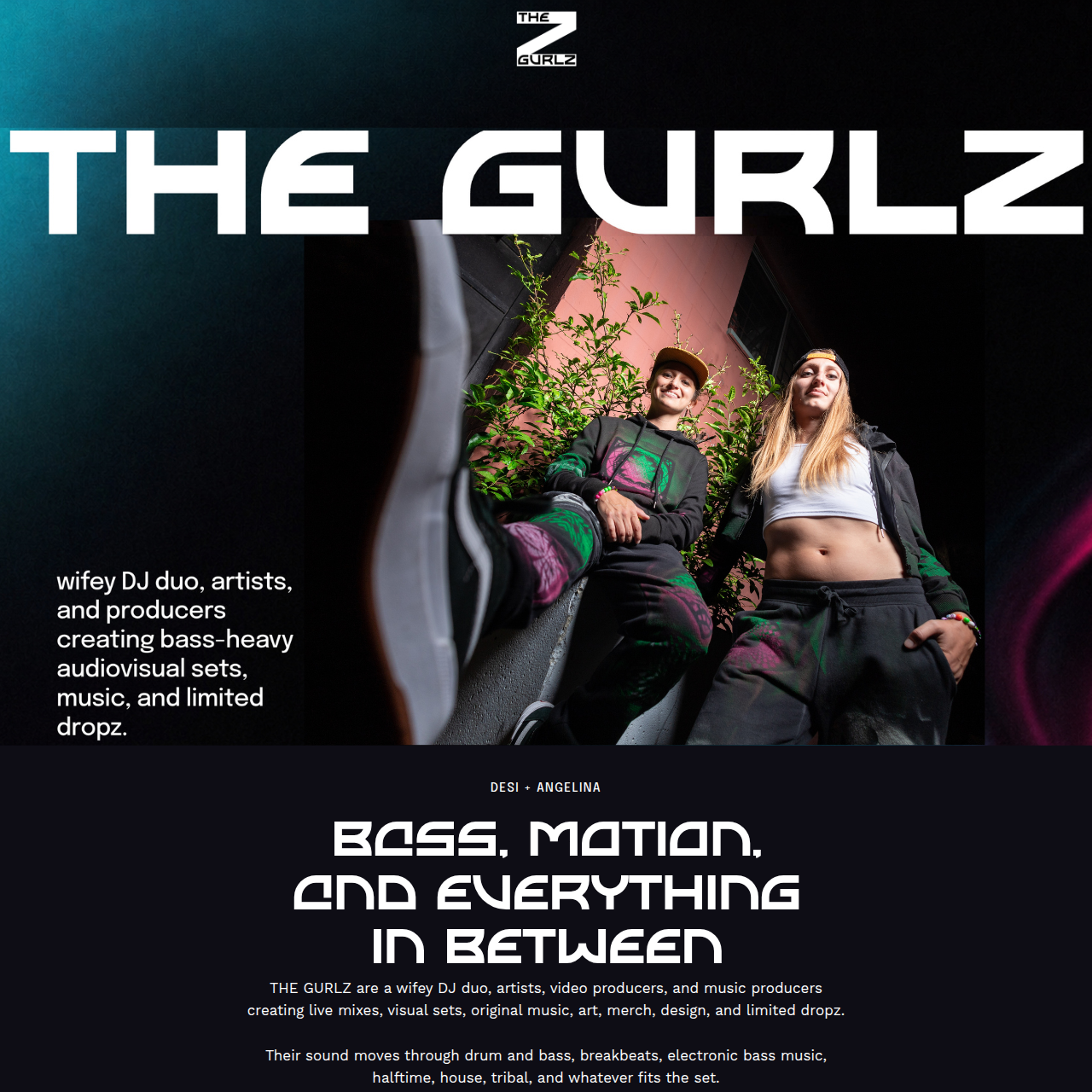
The sound moves through drum and bass, breakbeats, halftime, house, and tribal. The visuals come from wherever the set is recorded. No two releases are the same. Original music from their studio is coming soon, and more audiovisual sets are already in motion. Watch the full sets and see what immersive audiovisual DJ sets actually look and feel like at thegurlzofficial.com.
FAQ
What is bass-driven dance music in simple terms?
Bass-driven dance music is electronic music where low-frequency bass drives the rhythm and energy of the track. The bass is the lead instrument, not a supporting element.
What does a bass-forward mix mean?
A bass-forward mix places sub-bass and mid-bass frequencies at the front of the sound, letting them carry the track’s momentum while other elements support rather than compete.
What are the main types of bass music?
The main types include drum and bass (165–185 BPM), dubstep (140–150 BPM), halftime, breakbeats, and bass-forward house. Each has a distinct tempo range and rhythmic feel.
Why does bass music drive physical dancing?
Deep bass frequencies increase physical movement in dance settings. The sub-bass tones felt in the body, not just heard, trigger a physical response that pulls people to move.
What is inclusive bass music culture?
Inclusive bass music culture refers to the growing movement of collectives and events that center women, queer, gender-fluid, and nonbinary artists in lineups, production roles, and event staffing. It reflects the genre’s roots in marginalized communities.
IG: @thegurlzmusic, main social for behind-the-scenes and exclusive content
TikTok: @thegurlzofficial
Youtube: @TheGurlzOfficial
SoundCloud: https://soundcloud.com/thegurlz
www.thegurlzofficial.com
Recommended
- Bass Music Tempos for Dancers: The Complete BPM Guide – ☀︎THE GURLZ ☽ – WIFEY DJ DUO / ARTISTS / PRODUCERS
- The Role of BPM in Dance Music: A Dancer’s Guide – ☀︎THE GURLZ ☽ – WIFEY DJ DUO / ARTISTS / PRODUCERS
- What Is Rolling Bass in DnB: A Producer’s Guide – ☀︎THE GURLZ ☽ – WIFEY DJ DUO / ARTISTS / PRODUCERS
- Women DJs Breaking Bass Music Barriers: Who to Know – ☀︎THE GURLZ ☽ – WIFEY DJ DUO / ARTISTS / PRODUCERS


