
TL;DR:
- Bass music festival culture combines bass-forward genres, community, and visual art into shared, physical experiences. It emphasizes intentional design, participation, and rituals that foster deep community bonds beyond the event. Boutique festivals focus on care, art, and loyalty, ensuring a lasting connection to bass culture.
Bass music festival culture is the intentional fusion of bass-forward electronic music, community, visual art, and collective experience that shapes how attendees engage with these events. It is not passive. It is designed, felt, and remembered. The culture spans subgenres like dubstep, drum and bass, and trap, and it shows up in how festivals are built, how crowds move, and how communities form around shared sound. Bass and its subgenres made up 23% of artist representation at EDC 2026, compared to 43% for house. That gap tells you something real about the current festival landscape and why bass culture has carved out its own identity within it.
What is bass music festival culture explained?
Bass music is an umbrella term for bass-forward electronic genres including dubstep, drum and bass, and trap. Each subgenre carries its own tempo, texture, and crowd energy. Together, they define the sonic foundation of bass festivals.
Here is how the main subgenres show up at festivals:
- Drum and bass (DnB): Fast, rolling rhythms typically between 160–180 BPM. Crowds move constantly. The energy is relentless.
- Dubstep: Slower builds with heavy drops, usually around 140 BPM. The drop is the moment everything collapses into bass weight.
- Trap: Sits around 70–140 BPM with sharp hi-hats and deep 808 sub-bass. It pulls from hip-hop and electronic equally.
- Halftime: A slower, heavier cousin of DnB, sitting around 85–90 BPM. It hits harder than it looks on paper.
- Breakbeats: Chopped, syncopated drum patterns layered over bass. They create a groove that feels both familiar and unpredictable.
The bass music tempos across these subgenres directly shape how a crowd dances and how a festival stage feels. A DnB stage at 174 BPM creates a different physical experience than a halftime stage at 87 BPM. Festival programmers know this. Stage curation at bass events is deliberate, not random.
Bass music’s presence at major commercial events like EDC 2026 confirms it is no longer underground by default. It has moved into the main conversation while still carrying the identity markers of its roots: raw sound, physical impact, and community loyalty.
How do bass festivals create a shared sensory experience?
Bass music festivals engineer collective effervescence. That term, first used by sociologist Émile Durkheim, describes the feeling of losing individual identity inside a shared group experience. At bass festivals, that feeling is not accidental.
Research shows brainwave entrainment peaks at 1.65 Hz when synchronized with bass frequencies around 99 BPM. This means the body physically responds to the music in ways that align with the people around you. The crowd becomes one moving system.
“Bass frequencies at the right tempo do not just move the air. They move the nervous system. Festival designers who understand this are building experiences that operate below the level of conscious thought.”
Light shows, stage design, and crowd infrastructure amplify this effect. A well-designed bass stage uses subwoofer placement to push low frequencies through the floor, not just the air. You feel it in your chest, your legs, and your spine. That physical sensation is part of why bass music dominates festivals. It creates a body memory that house or pop music rarely matches.
Bass festivals also function differently from standard concerts. Festival culture is more participation than spectatorship, creating physically demanding but deeply rewarding experiences. You are not watching. You are inside it.
Pro Tip: If you want to feel the full effect of a bass stage, position yourself about 20–30 feet back from the main speakers. That is where the low-end frequencies converge and the sound hits as a complete system.
The underground electronic music roots of bass culture also shape the social norms at these events. Crowds tend to be more engaged, more aware of the music, and more likely to stay for a full set rather than drift between stages.
What should be on your bass music festival checklist?
Preparation is part of bass festival culture. Veterans treat the event as a pacing exercise, not a sprint. A bass music festival guide built for first-timers needs to cover gear, body management, and logistics.
Here is the core checklist:
- 10,000 mAh power bank. Your phone will die. Cellular networks at large festivals are overloaded. Charge before you need it.
- Government-issued photo ID. No exceptions. Bring a backup photo on a separate device.
- High-fidelity earplugs. Hearing protection is non-negotiable at 12–14 hour festival days. High-fidelity plugs reduce volume without killing the sound quality.
- SPF 50+ sunscreen. Outdoor bass festivals run through the afternoon heat. Sun damage accumulates fast when you are focused on the music.
- Broken-in, comfortable shoes. New shoes at a festival are a mistake you only make once.
- Electrolytes and salty snacks. Dancing for hours in heat depletes sodium fast. Water alone is not enough.
- Offline maps and a designated meeting point. Agree on a physical spot before you lose cell signal. Do not rely on texts.
Pro Tip: Set your meeting point at something visually distinct and permanent, like a specific art installation or a named gate. “Near the main stage” fails every time in a crowd of thousands.
Festival veterans warn that first-timers who skip hydration and hearing protection almost always regret it by day two. Bass music is physical. Treat your body like an instrument you need to keep in tune across the full weekend.
How do boutique festivals like Bass Coast and Shambhala shape bass culture?
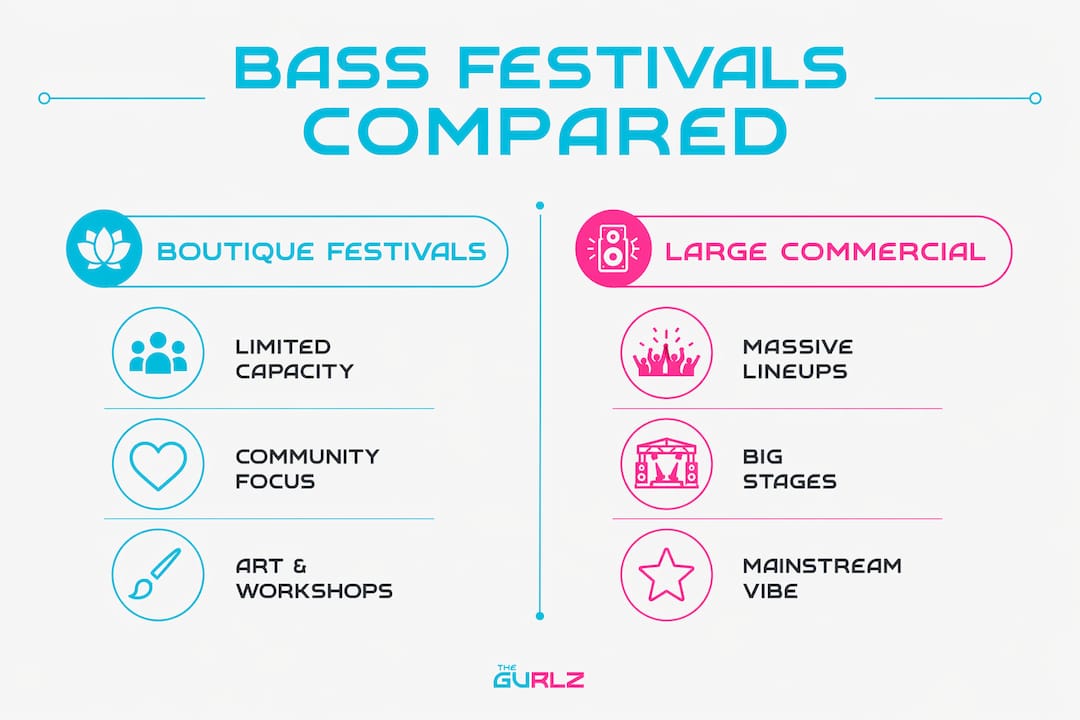
Scale changes everything at a festival. Boutique bass festivals operate on a different set of values than large commercial events, and those values produce a different kind of experience.
Bass Coast limits capacity and builds its identity around sound, art, workshops, and community care as foundational promises, not add-ons. Harm reduction and consent culture are woven into the event’s structure. The result is a festival that feels intentional at every level, from the stage programming to the volunteer infrastructure.
Shambhala functions as a ritual with strong community memory, stage loyalties, and care infrastructure that extends the culture beyond the event weekend. Returning attendees build a shared mythology around “the Farm.” Stage loyalty at Shambhala is real. People plan their entire schedule around one stage because that stage has a sound and a community they belong to.
| Feature | Boutique bass festivals | Large commercial events |
|---|---|---|
| Capacity | Limited, intentional | Tens of thousands |
| Harm reduction | Built into event DNA | Often supplemental |
| Art and workshops | Core programming | Secondary or absent |
| Community identity | Deep, returning crowd | Broad, transient audience |
| Stage loyalty | Strong, subgenre-specific | Weaker, genre-general |
The boutique model treats the festival as a temporary world. Music is the anchor, but the culture around it, the art, the workshops, the care infrastructure, is what makes people return year after year. That returning attendance is what builds a real bass music community rather than just an audience.
What role do rituals and community play beyond the music?
Bass festival culture extends well past the weekend. The rituals that form inside these events create social bonds that last.
- Returning attendance: Many bass festival attendees go back every year. That repetition builds identity. You are not just a ticket buyer. You are part of the place.
- Camp traditions: Shared camps develop their own rituals, inside jokes, and responsibilities. The camp becomes a home base with its own culture.
- Stage loyalties: Choosing your stage is a statement. At festivals like Shambhala, returning attendees build strong social identity and a sense of obligation to the community around that stage.
- Harm reduction participation: Veteran attendees often take on informal roles, checking in on newer attendees, sharing water, pointing people toward medical tents. Care is a cultural norm, not an exception.
- Memory-making: The stories from a bass festival weekend become part of how people define themselves. That shared memory is the glue that holds the community together between events.
Bass music festivals operate as rituals with deep-rooted community connections that encourage returning participation and shared memory-making. That is what separates a bass festival from a concert. The music opens the door. The community is what keeps people coming back.
Key Takeaways
Bass music festival culture is built on engineered sound, community rituals, and intentional design that transforms a weekend event into a lasting shared identity.
| Point | Details |
|---|---|
| Bass music is an umbrella term | Dubstep, drum and bass, trap, and halftime each shape festival energy differently. |
| Sound is engineered for collective experience | Bass frequencies around 99 BPM synchronize physical responses and dissolve individual identity in a crowd. |
| Preparation is part of the culture | A 10,000 mAh power bank, high-fidelity earplugs, electrolytes, and comfortable shoes are non-negotiable for 12–14 hour days. |
| Boutique festivals build deeper culture | Bass Coast and Shambhala integrate harm reduction, art, and community care as core programming, not extras. |
| Rituals extend the culture beyond the weekend | Camp traditions, stage loyalties, and returning attendance create community identity that outlasts the event. |
What THE GURLZ see that most people miss about bass culture
Most festival coverage focuses on the lineup. The artists, the stages, the headliners. That is the surface. What actually defines bass festival culture is the architecture underneath it: how sound is placed, how visuals interact with the music, how the environment shapes what the crowd feels.
THE GURLZ, Desi and Angelina, have built their entire creative practice around this idea. Their immersive audio-visual DJ sets do not separate the music from the visual world around it. The location is part of the set. The light, the texture, the movement of the space all get folded into the edit. That is not a production trick. It is a philosophy about how sound and place work together.
Bass festival culture at its best does exactly the same thing. The best stages are not just loud. They are designed. The sound system, the lighting, the crowd flow, the art installations, all of it works together to create something that feels bigger than any single element.
What gets lost at large commercial events is that intentionality. When scale becomes the priority, the details that make a bass experience genuinely transformative get diluted. Boutique festivals like Bass Coast and Shambhala protect those details fiercely. That is why their communities are so loyal.
THE GURLZ started with Bass & Breakz at Sunset Cliffs and continued with House in the Wild because the format demands that kind of specificity. Every set is mixed live, filmed on location, and edited to follow the music closely. The result is music you can watch and feel. That is what bass culture, at its core, is always reaching for.
— THE GURLZ OFFICIAL
THE GURLZ bring the bass festival feeling to every set
Bass festival culture lives in the details: the sound design, the visual world, the sense that something specific is happening in a specific place at a specific time.
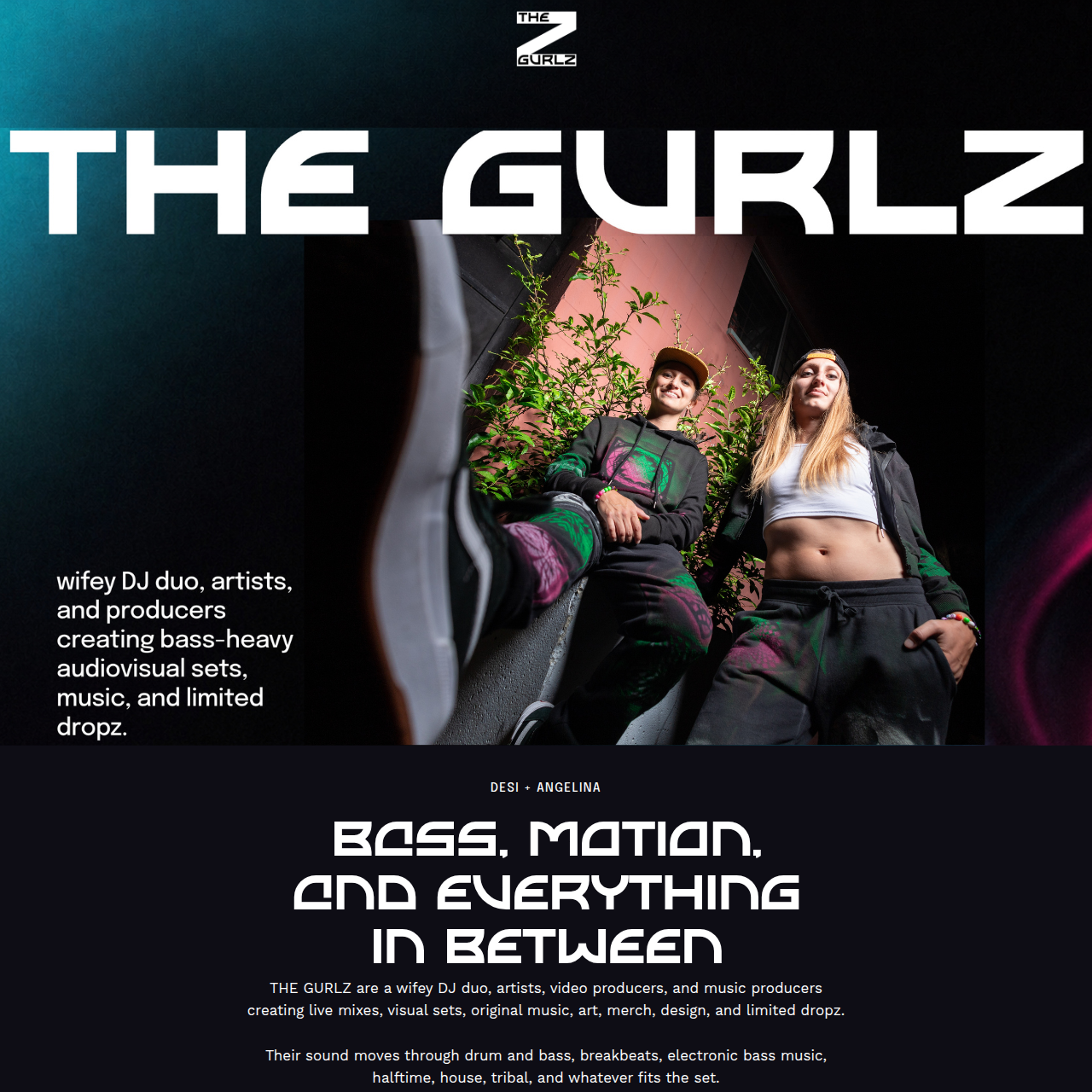
THE GURLZ, Desi and Angelina, build that feeling into every release. Their audio-visual DJ sets move through drum and bass, breakbeats, halftime, house, and tribal, mixed live and filmed on location. Bass & Breakz at Sunset Cliffs started the format. House in the Wild pushed it further. Each set is produced, filmed, mixed, and edited entirely by THE GURLZ. The visuals come from the location itself. Nothing is generic. If you want to see what location-based DJ sets look and feel like when the music and the visual world are built together, start there.
FAQ
What is a bass music festival?
A bass music festival is a multi-stage electronic music event centered on bass-forward genres like dubstep, drum and bass, trap, and halftime. These events are designed for active participation, with sound systems, lighting, and stage layouts built to create a collective physical and emotional experience.
Why does bass music dominate festival lineups?
Bass music creates a strong physical response in crowds through low-frequency sound, which synchronizes body movement and builds collective energy. That physical impact makes it one of the most effective genres for large-scale festival environments.
What should I bring to a bass music festival?
A 10,000 mAh power bank, government-issued ID, high-fidelity earplugs, SPF 50+ sunscreen, comfortable broken-in shoes, electrolytes, and an agreed offline meeting point are the core items for a 12–14 hour festival day.
What makes boutique bass festivals different from large commercial events?
Boutique festivals like Bass Coast and Shambhala limit capacity and integrate harm reduction, consent culture, art, and workshops as core programming. That intentional design creates deeper community identity and stronger returning attendance than large commercial events typically achieve.
How does bass festival culture extend beyond the music?
Camp traditions, stage loyalties, returning attendance, and community care norms create social bonds that outlast the festival weekend. Bass festivals function as rituals, with shared memory and belonging forming the foundation of the culture.
IG: @thegurlzmusic, main social for behind-the-scenes and exclusive content
TikTok: @thegurlzofficial
Youtube: @TheGurlzOfficial
SoundCloud: https://soundcloud.com/thegurlz
www.thegurlzofficial.com
Recommended
- House vs. Bass Music: What’s the Real Difference? – ☀︎THE GURLZ ☽ – WIFEY DJ DUO / ARTISTS / PRODUCERS
- How to Find Original Bass Electronic Music – ☀︎THE GURLZ ☽ – WIFEY DJ DUO / ARTISTS / PRODUCERS
- Women DJs Breaking Bass Music Barriers: Who to Know – ☀︎THE GURLZ ☽ – WIFEY DJ DUO / ARTISTS / PRODUCERS
- Underground Electronic Music Explained: A Cultural Deep Dive – ☀︎THE GURLZ ☽ – WIFEY DJ DUO / ARTISTS / PRODUCERS


