
TL;DR:
- Bass music is an umbrella term for electronic styles where low-end frequencies dominate the sound. Artists and audiences identify subgenres mainly through rhythm patterns and bass sound design rather than tempo.
Bass music is defined as an umbrella category of electronic styles where low-end frequencies lead the sound rather than support it. That distinction matters. It means dubstep, drum & bass, trap, UK bass, and future bass all live under the same roof, even though they sound nothing alike. Bass music subgenres explained correctly means understanding that “bass music” is a curatorial label, not a single genre. You hear it on festival stages, in club playlists, and in the sets of artists like THE GURLZ, who move through drum and bass, breakbeats, halftime, and house within a single performance.
What are the main subgenres of bass music?
Bass music covers dubstep, trap, drum & bass, UK bass, future bass, and halftime, each with its own tempo, rhythm structure, and bass sound design. Tempo gives you a starting point. Sound design tells you where you actually are.
Here is how the core subgenres break down:
- Dubstep: Runs at approximately 140 BPM with a half-time drum feel. The kick and snare land on beats 1 and 3, creating a slow, heavy pulse. Dubstep’s signature is the wobble bass, built from modulated sub-bass with dramatic drops. Melodic dubstep softens the aggression with expressive synths while keeping the bass-heavy structure.
- Drum & Bass (DnB): Runs at 170–178 BPM with rolling breakbeats. The fast, syncopated rhythm is the genre’s spine. Sub-bass moves underneath in long, sustained tones or intricate patterns depending on the subgenre.
- Trap: Variable BPM, typically 70–140 BPM, built on punchy 808 sub-bass hits and rapid hi-hat patterns. The 808 is the defining instrument. Its pitch, decay, and distortion level tell you everything about the track’s character.
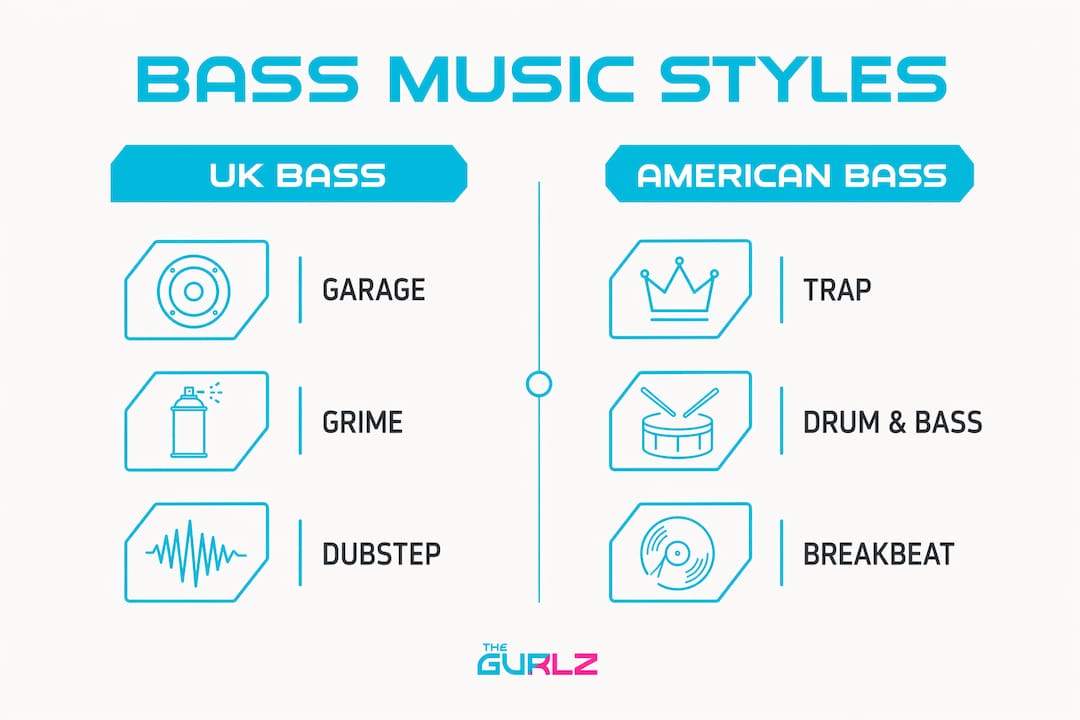
- UK Bass: Rooted in garage, grime, and 2-step. Runs at varied tempos with syncopated rhythms and a vocal-forward approach. The bass sits deep but leaves space for melody and texture.
- Future Bass: Sits around 150–160 BPM with lush, chord-based synths and heavy sub-bass drops. Emotional and melodic in character.
- Halftime: A subgenre of DnB that cuts the rhythmic density in half. Beats land slower and heavier, creating a meditative, weighty feel at DnB tempos.
Pro Tip: When you are trying to place a track, listen for the snare placement first. A snare on beat 3 at 140 BPM is dubstep. A snare on the offbeat at 170 BPM is DnB. That single detail narrows it down faster than any other method.
These subgenres share a commitment to bass as the lead voice. What separates them is how that bass is shaped, when it hits, and what rhythm pattern carries it.
How do regional influences shape bass music subgenres?
Cultural origin dictates sonic signature more than tempo does. Where a subgenre was born shapes its texture, its mood, and the way it moves a crowd.
The UK built its bass culture from the inside out. Garage and 2-step gave birth to grime, which fed into dubstep, which eventually split into UK bass as a distinct style. Each step added something: syncopation from garage, lyrical density from grime, sub-bass weight from dubstep. UK bass carries all of that history in its DNA. It sounds like a city that has been building something for decades.
North American bass culture developed differently. Festival culture in the United States pushed dubstep toward larger, more aggressive sound design. The drop became the event. Experimental bass scenes in cities like Denver, Los Angeles, and Portland pulled in influences from hip-hop, psychedelia, and world music, creating hybrid styles that resist easy labeling. Denver, in particular, built a reputation as a bass music hub, with a scene that values genre fluidity and raw energy.
Regional differences also show up in how bass music is performed and presented:
- UK club culture favors tight, technical mixing and genre loyalty within a set.
- North American festival culture rewards genre blending and high-impact moments.
- Both scenes have produced artists who cross regional lines and pull from both traditions.
THE GURLZ, originally based in Denver, reflect the North American approach. Their sets move through drum and bass, breakbeats, house, and tribal sounds within a single performance. The location shapes the set. The energy shapes the selection.
What distinguishes drum & bass subgenres like liquid, neurofunk, jump-up, and jungle?
Drum & bass subgenres split along two axes: the texture of the breakbeat and the character of the bass. Get those two elements right and you can place almost any DnB track accurately.
Here are the four main DnB subgenres and what defines each:
- Liquid DnB: Melodic, soulful, and atmospheric. The bass is smooth and sustained. Vocals and pads sit high in the mix. Liquid sets feel warm and continuous, built for sustained listening rather than single-moment impact.
- Neurofunk: Dark, technical, and dense. The bass is modulated heavily, with growls, clicks, and pitch shifts that feel almost mechanical. Neurofunk production focuses on energy distribution and intricate bass modulation rather than pure tempo. Mixing neurofunk requires precise beatmatching because the rhythmic density leaves no room for error.
- Jump-Up: Playful and crowd-focused. The bassline is simple, bouncy, and designed to move bodies. Jump-up sets are high-energy and accessible, built for peak-hour moments.
- Jungle: The oldest of the four. Jungle’s raw breakbeat feel separates it from the cleaner production of modern DnB. The breaks are chopped and layered with a rougher texture. Sub-bass interplay with the breakbeat creates a groove that feels physical and urgent.
| Subgenre | Tempo | Bass character | Mood |
|---|---|---|---|
| Liquid DnB | 170–178 BPM | Smooth, sustained | Warm, melodic |
| Neurofunk | 170–178 BPM | Modulated, technical | Dark, intense |
| Jump-Up | 170–178 BPM | Bouncy, simple | Energetic, playful |
| Jungle | 160–170 BPM | Raw, layered | Gritty, urgent |
Pro Tip: Mixing across DnB subgenres in a single set works best when you use halftime tracks as bridges. A halftime drop at 174 BPM gives the crowd a breath between a neurofunk sequence and a liquid section without breaking the tempo.
The percussive weight of the breakbeat is the crucial factor. It moves the listener physically before the bass even registers consciously. That is why DnB crowds respond so differently to liquid versus jump-up, even at identical tempos.
How do tempo, rhythm, and bass design differentiate bass music subgenres?
Identifying a subgenre relies on bass role and rhythmic feel more than BPM alone. Tempo overlaps are common across bass music. Trap and dubstep can share a BPM. House-based bass music runs at 120–130 BPM, the same range as many non-bass electronic styles. The number alone tells you almost nothing.
Rhythm pattern is the first real differentiator. A four-on-the-floor kick pattern at 128 BPM places you in house territory. The same tempo with a syncopated, swung kick places you in UK bass or garage. Breakbeats at any tempo signal DnB or jungle. Half-time drum feels at 140 BPM signal dubstep or halftime. The pattern is the genre.
Bass sound design is the second differentiator. A wobble bass built from an LFO-modulated oscillator is dubstep. A pitched 808 with long decay is trap. A smooth, sustained sub-bass tone is liquid DnB. A growling, formant-shifted bass is neurofunk. You can often identify the subgenre from the bass alone, with no other information.
Bass subgenres hybridize constantly, blending house, techno, and trap in ways that make rigid labels less useful than understanding energy. Genre drift means production techniques from one style quickly move into others. A track can carry a DnB tempo, a trap-style 808, and a house chord progression simultaneously. Genre labels grow porous when artists focus on innovation over strict category. The more useful question is not “what genre is this?” but “what does this track do to the room?”
For listeners and DJs, the role of BPM matters most as a starting point for energy management, not genre classification. A set that moves from 128 BPM house-bass to 140 BPM halftime to 174 BPM liquid DnB tells a story through tempo. The bass design at each stage tells the emotional part of that story.
Key Takeaways
Bass music is best understood through rhythm pattern and bass sound design, not tempo alone, because BPM overlaps across subgenres make it an unreliable classifier.
| Point | Details |
|---|---|
| Bass music is an umbrella term | It groups dubstep, trap, DnB, UK bass, and more under one bass-forward identity. |
| Rhythm pattern identifies genre | Four-on-the-floor, breakbeat, and half-time feels each signal a different subgenre. |
| Bass sound design is the key | Wobbles, 808s, growls, and smooth tones define genre identity more than BPM. |
| Regional origin shapes sound | UK bass carries garage and grime DNA; North American bass leans festival and experimental. |
| Hybrids are the norm | Genre lines blur constantly; energy and vibe matter more than strict labels. |
Why genre labels are the wrong starting point
Desi and Angelina of THE GURLZ have built their sets around a truth that most genre guides avoid: the label is the last thing that matters. When they filmed and mixed Bass & Breakz at Sunset Cliffs, the set moved through drum and bass, breakbeats, and bass-forward electronic music without stopping to announce a genre change. The location, the light, and the energy of the moment shaped the selection. The genre followed the feeling.
Most listeners approach bass music backward. They learn the labels first and then try to fit what they hear into a box. That works for a while. Then you encounter a track that carries DnB tempo, trap bass, and a house chord structure, and the box breaks. The better approach is to train your ear on the elements: the rhythm pattern, the bass texture, the mood. Those elements are consistent. The labels are not.
The subgenres covered here are real and useful. Knowing the difference between neurofunk and liquid DnB changes how you listen, how you move, and how you build a set. But the moment you treat those labels as walls instead of reference points, you stop hearing what the music is actually doing. THE GURLZ build every set from the inside out. The sound comes first. The category, if it matters at all, comes later.
For anyone new to bass music, the advice is simple. Pick one subgenre. Listen to it until you can feel the rhythm pattern in your body. Then listen to something adjacent and notice what changed. That process, repeated across dubstep, DnB, trap, and UK bass, builds the kind of ear that no genre guide can give you.
— THE GURLZ OFFICIAL
THE GURLZ audio-visual sets: bass music in motion
Bass music is easier to understand when you can watch it happen in real time. THE GURLZ build immersive audio-visual DJ sets that move through drum and bass, breakbeats, halftime, house, and tribal sounds within a single performance. Every set is mixed live, filmed on location, and edited by Desi and Angelina themselves.
Bass & Breakz at Sunset Cliffs was the first release in this format. House in the Wild continued it. Each set is shaped by the location, the time of day, and the energy of the moment. The visuals are not decoration. They follow the music closely, cut to the rhythm, and reflect the world around the set. If you want to hear how bass subgenres connect in practice, watch the sets and let the music do the explaining.
FAQ
What is bass music exactly?
Bass music is an umbrella term for electronic styles where low-end frequencies lead the sound. It covers dubstep, drum & bass, trap, UK bass, and related genres, and it appears most often as a curatorial label for festival stages and playlists.
What BPM is bass music?
Bass music spans a wide tempo range. Dubstep runs at approximately 140 BPM, drum & bass at 170–178 BPM, and house-based bass styles at 120–130 BPM. BPM alone does not identify a subgenre.
What is the difference between dubstep and drum & bass?
Dubstep runs at approximately 140 BPM with a half-time drum feel and wobble bass. Drum & bass runs at 170–178 BPM with rolling breakbeats and sustained sub-bass. The rhythm pattern and tempo are the clearest points of separation.
How do you identify a bass music subgenre?
Listen for the rhythm pattern first, then the bass sound design. A half-time feel at 140 BPM with a wobble bass is dubstep. Fast breakbeats at 170 BPM with a smooth bass tone is liquid DnB. BPM is a starting point, not a definitive answer.
What makes UK bass different from American bass music?
UK bass carries the DNA of garage, 2-step, and grime, giving it a syncopated, vocal-forward character. North American bass music leans toward festival-scale dubstep and experimental hybrid styles shaped by hip-hop and psychedelic influences.
IG: @thegurlzmusic, main social for behind-the-scenes and exclusive content
TikTok: @thegurlzofficial
Youtube: @TheGurlzOfficial
SoundCloud: https://soundcloud.com/thegurlz
www.thegurlzofficial.com
Recommended
- Bass-Driven Dance Music: What Festival-Goers Need to Know – ☀︎THE GURLZ ☽ – WIFEY DJ DUO / ARTISTS / PRODUCERS
- House vs. Bass Music: What’s the Real Difference? – ☀︎THE GURLZ ☽ – WIFEY DJ DUO / ARTISTS / PRODUCERS
- How to Find Original Bass Electronic Music – ☀︎THE GURLZ ☽ – WIFEY DJ DUO / ARTISTS / PRODUCERS
- What Is Rolling Bass in DnB: A Producer’s Guide – ☀︎THE GURLZ ☽ – WIFEY DJ DUO / ARTISTS / PRODUCERS


