
TL;DR:
- Breakbeat is a style of electronic music built on sample-based, rearranged drum breaks from funk, soul, and R&B records. Its rhythmic foundation has influenced genres like jungle, drum and bass, and UK garage, shaping modern bass music culture. The Amen break, a 7-second drum solo from 1969, plays a central role in the genre’s history and ongoing evolution.
Breakbeat is defined as a style of electronic music built on syncopated drum breaks sampled from 1970s funk, soul, and R&B records. These breaks are not looped passively. They are chopped, rearranged, and layered to create rhythms that resist the rigid pulse of standard 4/4 house or techno. The genre’s rhythmic foundation traces directly to hip-hop DJs who isolated the drum sections of funk records to keep dancers moving. From that single technique, an entire family of subgenres grew: jungle, drum and bass, Big Beat, Nu-Skool Breaks, and Florida Breaks. The Amen break, a 7-second drum solo from 1969, sits at the center of that history. Understanding the breakbeats genre explained in full means understanding rhythm as a living, mutable thing rather than a fixed grid.
What are the origins and history of breakbeat music?
Breakbeat music began with a simple act: a DJ lifting the needle back to the start of a drum break so the crowd never had to stop dancing. Hip-hop DJs in New York during the mid-1970s, most notably DJ Kool Herc, used two copies of the same record to extend the percussive section indefinitely. That technique, called the “merry-go-round,” made the drum break the center of the performance rather than a brief moment inside a song.
The raw material came from funk and soul drum breaks recorded in the late 1960s and 1970s. Tracks by James Brown, The Incredible Bongo Band, and The Winstons supplied the most durable breaks. Producers and DJs recognized that these recordings contained a rhythmic energy that synthesized drum machines could not replicate.
By the late 1980s, breakbeat techniques crossed the Atlantic. The UK rave scene absorbed the sound and pushed it toward higher tempos and heavier bass. Key developments in that transition include:
- Early UK rave culture adopted breakbeat rhythms from American hip-hop and house records circulating on import.
- Warehouse parties and outdoor raves in the late 1980s created demand for music that hit harder and moved faster than standard house.
- UK rave events in the early 1990s drew crowds of 10,000 to 25,000 people, with venues like Labrynth, Shelley’s Laserdome, The Eclipse, and Sanctuary Music Arena becoming central to the scene.
- By 1992, the sound had fractured into distinct subgenres: darkcore, happy hardcore, and jungle each claimed their own tempo range and aesthetic.
- Jungle evolved directly into drum and bass, carrying the breakbeat rhythmic structure forward into the mid-1990s and beyond.
That fragmentation was not a sign of collapse. It was the genre proving how much creative territory a single rhythmic concept could cover.
What are the defining musical characteristics of breakbeat?
Breakbeat music is defined by its refusal to land on every beat. Where house and techno place a kick drum on beats 1, 2, 3, and 4 with mechanical regularity, breakbeat rhythms skip, anticipate, and syncopate. That asymmetry is the genre’s core identity.
Rhythm and groove
The drum patterns in breakbeat come from real performances, not programmed grids. Producers sample these recordings and then slice them into individual hits: kick, snare, hi-hat, and ghost notes. Rearranging those slices creates new patterns that retain the original recording’s human feel. The result is a groove that breathes rather than marches.
Tempo across subgenres
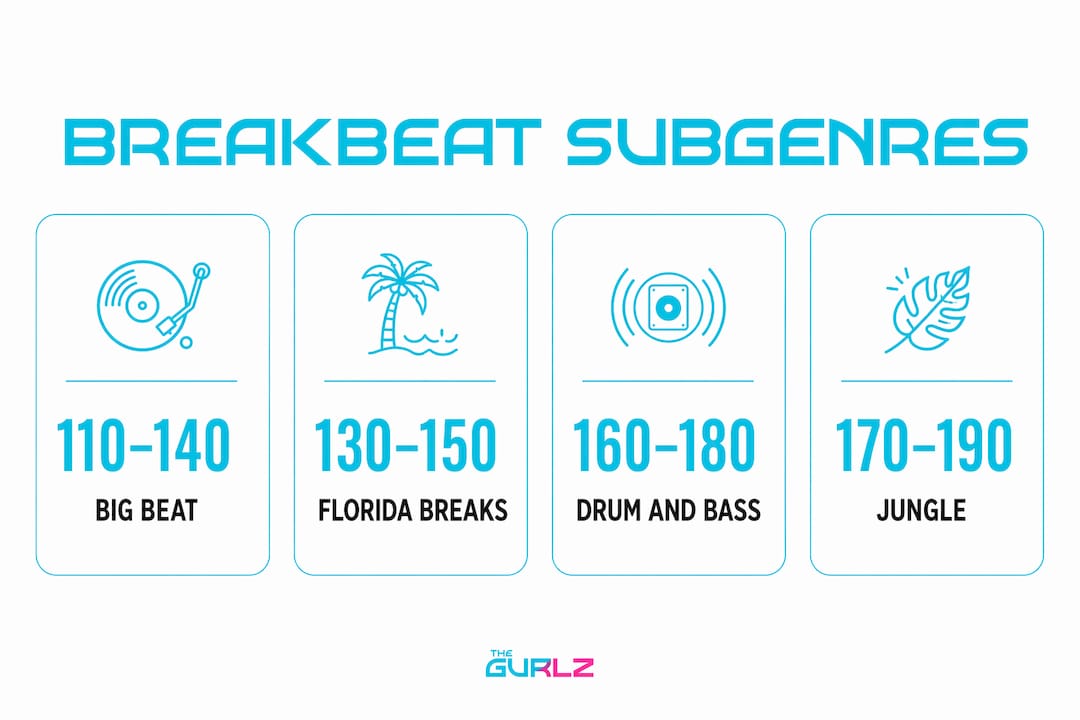
Breakbeat tempo ranges vary significantly by subgenre. Big Beat runs from 110 to 140 BPM. Florida Breaks sits between 130 and 140 BPM. Nu-Skool Breaks occupies 125 to 135 BPM. Dariacore pushes into 150 to 180 BPM territory. That spread means a DJ organizing a breakbeat set needs to think carefully about which subgenres sit next to each other in the mix.
| Subgenre | BPM Range | Key Characteristic |
|---|---|---|
| Big Beat | 110–140 | Rock-influenced, heavy drops, wide mainstream appeal |
| Nu-Skool Breaks | 125–135 | Funk-forward, melodic basslines, club-focused |
| Florida Breaks | 130–140 | Energetic, crowd-driven, festival-ready |
| Dariacore | 150–180 | Hyper-speed, sample-dense, experimental |
Production texture
Breakbeat tracks layer sampled breaks with synthesized basslines, melodic hooks, and found sounds. The bassline often carries as much rhythmic information as the drums. Producers treat sampling as musical archaeology, digging through records to find breaks with the right weight and character, then building an entirely new track around that foundation. That approach produces music with depth that purely synthesized tracks rarely match.
Pro Tip: When comparing breakbeat to house or techno, listen specifically to where the snare falls. In 4/4 house, the snare hits beats 2 and 4 like clockwork. In breakbeat, the snare moves around those positions, creating tension and release that feels unpredictable even after repeated listens.
How has the Amen break shaped breakbeat and its subgenres?
The Amen break originated from a 7-second drum solo performed by Gregory Coleman on the 1969 track “Amen, Brother” by The Winstons. Coleman played a short, unaccompanied break near the end of the song. That moment became one of the most sampled recordings in music history.
Hip-hop producers discovered the break in the 1980s and used it as a rhythmic bed for countless tracks. When breakbeat culture moved into electronic music, producers began treating the Amen break not as a loop but as raw material. The techniques they applied include:
- Slicing: Cutting the break into individual drum hits and rebuilding the pattern from scratch.
- Pitch shifting: Raising or lowering the pitch of the entire break or individual slices to match a track’s key or create a darker tone.
- Time-stretching: Altering the tempo of the break without changing its pitch, allowing it to fit any BPM target.
- Layering: Combining the Amen break with other drum samples or synthesized percussion to create a denser, more complex sound.
- Resequencing: Rearranging the slices into entirely new rhythmic patterns that bear little resemblance to the original recording.
“The Amen break’s lasting power comes from its asymmetry and swing that resist resolution. Every generation finds new ways to slice, layer, and distort it to keep it vital.”
— Music journalist Matthew Clement, as cited in Drum and Bass: Six Seconds That Changed Music
The Amen break powered jungle’s rise in the early 1990s and remained central to drum and bass as that genre developed. Its influence extends into UK garage, grime, and contemporary bass music. The break works because its original performance contained imperfections and micro-timing variations that make it feel alive at any tempo.
What practical tips and techniques should DJs and producers know about breakbeat?
Producing and mixing breakbeat music requires a different mindset than working with straight 4/4 rhythms. The genre rewards producers who understand why the groove works, not just how to copy its surface features.
-
Preserve the swing when chopping breaks. New producers often lose the organic feel by quantizing breaks to a rigid grid. The correct approach is slicing the break into individual hits and manually rearranging them, keeping the micro-timing variations that give the groove its character.
-
Use 130 BPM as your DJ anchor. The practical DJ target for organizing a breakbeat set is 130 BPM. Most Nu-Skool Breaks and Florida Breaks tracks sit near that number, making transitions smoother and reducing the need for extreme pitch correction.
-
Check phrasing, not just BPM. Beatgrid and phrasing alignment is essential when mixing across breakbeat subgenres. Big Beat and Nu-Skool Breaks share overlapping tempos but use different phrase lengths and drop structures. Relying on BPM alone causes tracks to drift out of sync mid-mix.
-
Layer synthesized elements over sampled breaks. A sampled break provides the rhythmic skeleton. Adding a synthesized sub-bass, a melodic hook, or a processed vocal on top creates the full track. The combination of sampled and synthesized elements produces music that hits well on large festival sound systems.
-
Study the bass music tempo map. Understanding how bass music tempos relate across breakbeat, drum and bass, and halftime helps DJs build sets that move logically from one energy level to the next without jarring tempo jumps.
Pro Tip: When building a breakbeat set, group tracks by subgenre first, then by energy level within each group. Moving from Nu-Skool Breaks into Florida Breaks at a similar BPM feels natural. Jumping from Big Beat into Dariacore without a transition track creates a wall of confusion on the dancefloor.
THE GURLZ apply these principles in their live sets. Desi and Angelina mix breakbeat rhythms live, reading the room and adjusting the energy in real time. Their audio-visual DJ sets pair that live mix with visuals that respond to the music’s movement and texture.
What is the cultural impact and ongoing influence of breakbeat music today?
Breakbeat did not stay contained within its own scene. The rhythmic logic it introduced spread into nearly every corner of electronic music that followed it.
- Jungle and drum and bass took the breakbeat template and pushed it to 160–180 BPM, creating one of the most technically demanding DJ formats in dance music. The connection between DnB and dance culture runs directly through breakbeat’s rhythmic DNA.
- UK garage borrowed the syncopated feel of breakbeat and applied it to a 2-step rhythm at 130 BPM, producing a sound that later fed into grime and dubstep.
- Dubstep inherited the half-time feel that producers derived from slowing breakbeat patterns down and emphasizing the space between hits.
- Festival culture owes a structural debt to breakbeat. The large-scale UK raves of the early 1990s established the format of the modern bass music festival, from sound system scale to crowd behavior.
- Sampling culture as a creative practice was normalized by breakbeat producers who demonstrated that a 7-second drum recording could anchor an entire genre for decades.
THE GURLZ carry that tradition forward in a specific way. Their sets move through breakbeats, drum and bass, halftime, house, and tribal, treating each genre as a chapter in a longer story. The visual layer they add, filmed and edited by Desi and Angelina themselves, gives the music a physical location. Bass & Breakz at Sunset Cliffs placed breakbeat rhythms against the Pacific coast. House in the Wild moved the format into open natural space. Each set is its own document of where the music was played and what it felt like to be there.
Key Takeaways
Breakbeat is defined by syncopated sampled drum breaks, and that single rhythmic concept has generated more genre diversity than almost any other idea in electronic music history.
| Point | Details |
|---|---|
| Core definition | Breakbeat uses chopped, rearranged drum breaks from funk and soul records as its rhythmic foundation. |
| Amen break centrality | Gregory Coleman’s 1969 drum solo remains the most sampled break in music history, powering jungle, DnB, and beyond. |
| Tempo varies by subgenre | BPM ranges from 110 (Big Beat) to 180 (Dariacore); 130 BPM is the practical DJ anchor for most sets. |
| Swing must be preserved | Quantizing breaks to a rigid grid destroys the organic feel; slice and rearrange manually to keep the groove alive. |
| Cultural reach | Breakbeat’s rhythmic logic shaped jungle, drum and bass, UK garage, dubstep, and modern festival culture. |
Breakbeat from where we stand
Breakbeat is the genre that taught electronic music how to be human. Every other style we work with, drum and bass, halftime, tribal, house, carries some trace of that original idea: take a real drum performance, break it apart, and rebuild it into something new.
What gets lost in most genre explainers is how physical breakbeat actually is. The asymmetry is not an accident or a stylistic choice. It is a direct consequence of sampling real musicians playing real instruments with real imperfections. When you hear a breakbeat track hit right, you feel it in your chest and your feet at the same time. That is not something a programmed 4/4 kick pattern does.
Desi and Angelina have mixed breakbeat rhythms in sets from coastal cliffs to open wilderness. The music does something different in each location. The visuals they film and edit around it change what the rhythm means. A breakbeat pattern at sunset over the Pacific feels nothing like the same pattern in a dark club. Location is part of the music.
The producers who keep breakbeat alive are the ones who treat the Amen break and its relatives as starting points, not finished products. Every generation slices it differently. That is exactly how it should work.
— THE GURLZ OFFICIAL
THE GURLZ and the breakbeat experience
THE GURLZ bring breakbeat off the screen and into the world. Their audio-visual DJ sets, starting with Bass & Breakz at Sunset Cliffs and continuing with House in the Wild, place live mixed breakbeat and bass music inside real locations with visuals that follow the music closely.
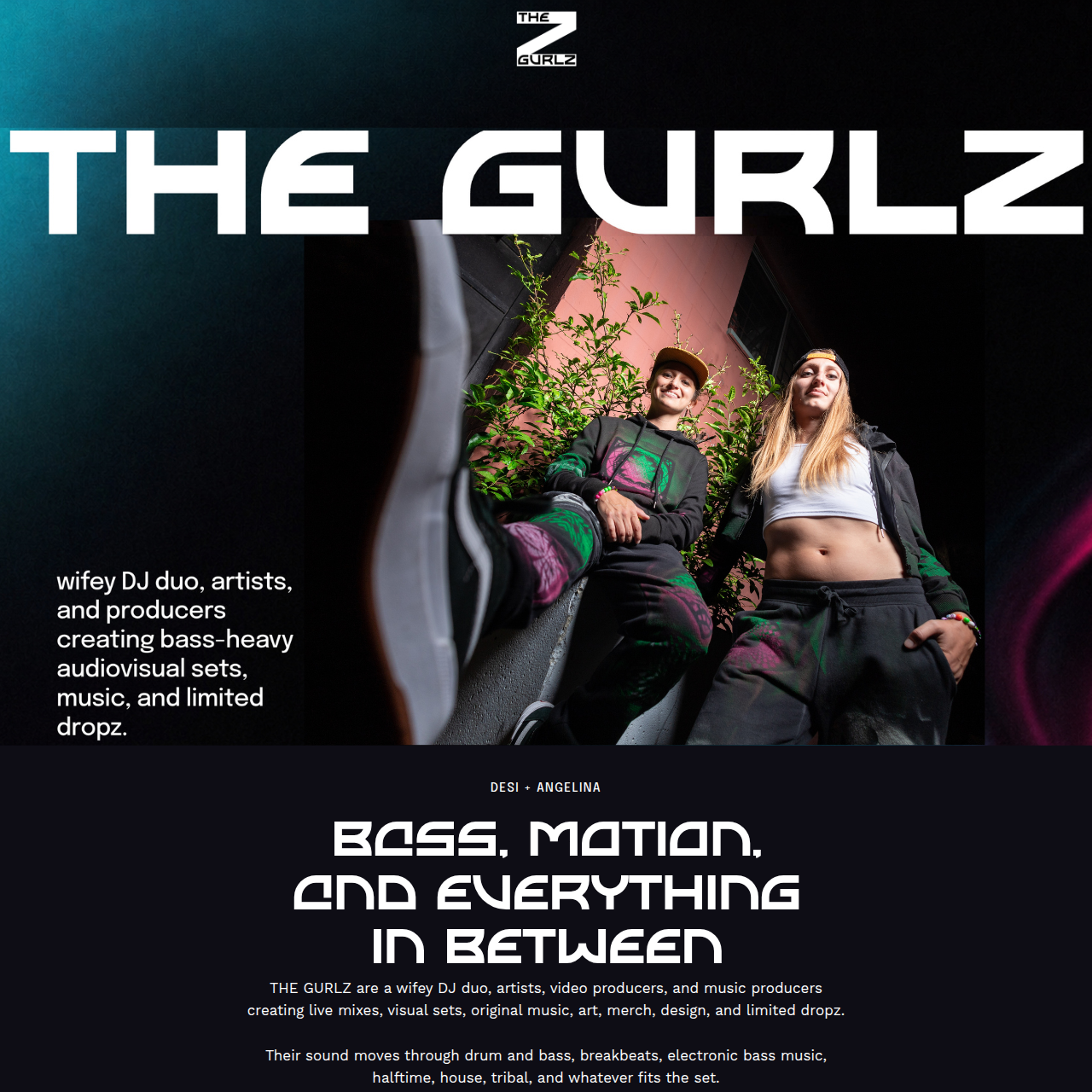
Desi and Angelina produce, film, mix, and edit every set themselves. The music is live. The visuals come from the location, the light, and the movement around the set. Each release pushes the format further. Watch their live audio-visual sets and see what breakbeat looks like when the visual world is built around the rhythm. More sets and original music are in motion now. Follow along for what comes next.
IG: @thegurlzmusic, main social for behind-the-scenes and exclusive content
TikTok: @thegurlzofficial
Youtube: @TheGurlzOfficial
SoundCloud: https://soundcloud.com/thegurlz
www.thegurlzofficial.com
FAQ
What is a breakbeat in music?
A breakbeat is a drum break sampled from a funk, soul, or R&B recording and rearranged to create a syncopated rhythm. Hip-hop DJs first used these breaks in the 1970s to sustain dancefloor energy, and electronic producers later built entire genres around them.
What BPM is breakbeat music?
Breakbeat tempo ranges from 110 BPM (Big Beat) to 180 BPM (Dariacore), with 130 BPM serving as the practical anchor for most DJ sets. Nu-Skool Breaks and Florida Breaks both cluster near that 130 BPM mark.
What is the Amen break and why does it matter?
The Amen break is a 7-second drum solo recorded by Gregory Coleman on the 1969 track “Amen, Brother” by The Winstons. It became the most sampled drum break in music history and forms the rhythmic foundation of jungle, drum and bass, and much of modern breakbeat culture.
How is breakbeat different from house or techno?
House and techno use a four-on-the-floor kick pattern where the kick drum hits every beat. Breakbeat uses syncopated, asymmetric patterns derived from real drum performances, creating a groove that feels unpredictable and human rather than mechanical.
What genres came from breakbeat music?
Breakbeat directly produced jungle, drum and bass, Big Beat, Nu-Skool Breaks, and Florida Breaks. Its rhythmic influence also shaped UK garage, dubstep, and grime, making it one of the most generative rhythmic concepts in electronic music history.
Recommended
- How to Find Original Bass Electronic Music – ☀︎THE GURLZ ☽ – WIFEY DJ DUO / ARTISTS / PRODUCERS
- The Role of BPM in Dance Music: A Dancer’s Guide – ☀︎THE GURLZ ☽ – WIFEY DJ DUO / ARTISTS / PRODUCERS
- Bass Music Tempos for Dancers: The Complete BPM Guide – ☀︎THE GURLZ ☽ – WIFEY DJ DUO / ARTISTS / PRODUCERS
- Women DJs Breaking Bass Music Barriers: Who to Know – ☀︎THE GURLZ ☽ – WIFEY DJ DUO / ARTISTS / PRODUCERS


