
TL;DR:
- Drum and bass is a fast electronic genre with tempos between 165 and 185 BPM, heavy basslines, and complex rhythms. It evolved from the UK rave scene in the early 1990s, blending influences like reggae, hip-hop, and techno, and has diversified into subgenres like liquid, neurofunk, and jump-up. The genre’s signature sound stems from breakbeat chopping, deep bass design, and innovative sound layering.
Drum and bass, commonly shortened to DnB, is a fast-paced electronic music genre built on tempos between 165 and 185 BPM, heavy sub-bass lines, and syncopated breakbeats. It sits firmly within electronic dance music but carries a distinct energy that sets it apart from most other genres in the space. The sound is physical. The bass hits low, the drums move fast, and the rhythms layer in ways that keep you locked in.
The core elements that define the genre:
- Tempo: 165–185 BPM, faster than most dance music
- Breakbeats: chopped, looped, and resequenced drum patterns
- Sub-bass: deep, rolling basslines that anchor the mix
- Samples and synthesizers: layered textures from both digital and analog sources
- Complex rhythms: syncopation and polyrhythm across drum tracks
If you are new to drum and bass or looking to go deeper, this guide covers the history, the subgenres, the artists, and the best ways to find and hear it in the US right now.
How did drum and bass start and evolve?
Drum and bass emerged in the early 1990s from the UK rave scene, growing directly out of jungle music and breakbeat hardcore. The genre pulled from reggae, dub, hip-hop, funk, jazz, and techno, blending those influences into something that felt entirely new. It was underground from the start, spread through pirate radio stations and warehouse parties across London and Bristol.
Key moments in the genre’s development:
- Late 1980s: UK rave and breakbeat hardcore scenes lay the groundwork
- 1991: Lennie De Ice’s We Are I.E. combines breakbeats with reggae-influenced basslines, cited as an early precursor to jungle and DnB
- Early 1990s: Producers like 4hero, Doc Scott, LTJ Bukem, Goldie, and Grooverider begin shaping the sound by stripping back hardcore elements and pushing bass and drum complexity
- Mid-1990s: Subgenres branch out, including techstep, jump up, and the more melodic liquid funk, pioneered by artists like High Contrast and Calibre
- 1997: Roni Size and Reprazent’s album New Forms wins the Mercury Prize, bringing critical recognition to the genre
- Late 1990s: Darker styles like neurofunk develop as DnB moves from pirate radio to commercial stations
- 2005: Pendulum’s Hold Your Colour becomes the best-selling drum and bass album
- 2012: DJ Fresh’s “Hot Right Now” (featuring Rita Ora) becomes the first DnB track to hit UK No. 1, and one of the fastest-selling singles of that year
- 2024: Chase & Status and Stormzy’s “BACKBONE” tops the UK charts, proving the genre’s mainstream reach is still growing
The genre has never stopped moving. Producers continue pushing sound design to keep DnB high-energy and technically ahead of most other electronic styles.
What makes drum and bass sound the way it does?
The signature DnB sound comes from a specific set of production choices, most of them rooted in how drums and bass interact. Speed is part of it, but the real character comes from rhythm and texture.
The Amen Break is the most important sample in the genre’s history. It comes from a six-second drum solo on The Winstons’ 1969 track “Amen, Brother.” Early jungle and DnB producers looped, chopped, and pitched that break into the rhythmic foundation the genre still builds on today. It is not just a sample. It is a blueprint.
Core production elements:
- Breakbeat chopping: drum loops sliced and rearranged to create syncopated patterns
- Sub-bass design: deep basslines often created with synthesizers tuned to frequencies felt as much as heard
- Layering: multiple drum elements stacked to create density and movement
- Resampling: taking existing sounds and processing them through distortion and compression to create new textures, especially in heavier subgenres like neurofunk
- Sound design: synthesizers, samplers, and computers working together to build the sonic world around the drums
The bass music subgenres that grew out of DnB each took these tools in a different direction, which is why liquid funk and neurofunk can both be called drum and bass while sounding almost nothing alike.
What are the main subgenres of drum and bass?
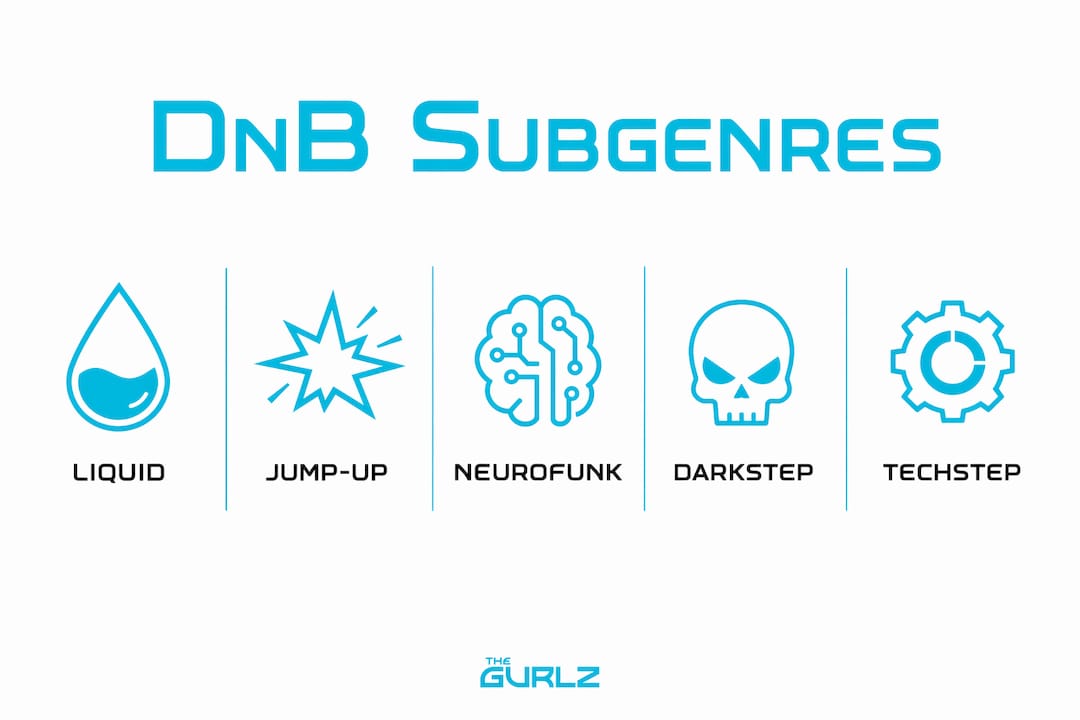
DnB is not one sound. It is a family of sounds, and knowing the subgenres helps you find the corner of the genre that fits you.
The main subgenres:
-
Liquid DnB: melodic, vocal-heavy, and smooth. Built on harmonic grooves and emotional basslines. Artists like Calibre and High Contrast define this space. It works in headphones as well as on a dancefloor.
-
Neurofunk: darker and more industrial. Neurofunk production uses resampling and complex layering to build aggressive, distorted bass textures. It is peak-hour music, designed for intensity.
-
Jump-up: heavy, energetic, and less serious than other subgenres. Characterized by robotic bass sounds and a sense of humor that most DnB styles skip. Mid-1990s in origin, still a crowd favorite.
-
Techstep: influenced by techno and science-fiction aesthetics. Cold, mechanical, and precise. It pushed DnB toward darker, more industrial territory in the late 1990s.
-
Intelligent DnB / Liquid Funk: smoother and more ambient-influenced, pioneered by LTJ Bukem and his label Good Looking Records, along with artists like Omni Trio and Photek.
-
Jazzstep: draws from jazz scales, rhythms, and instrumentation. Alex Reece and LTJ Bukem were early figures here.
-
Sambass: a Brazilian offshoot incorporating samba and bossa nova elements, pioneered by DJ Marky.
Each subgenre attracts a different kind of listener. If you want something to feel, start with liquid. If you want something to move to at volume, jump-up or neurofunk will get there faster.
Who are the best DnB artists to know?
The genre was built by a tight group of producers and DJs, most of them based in the UK. Their influence still shapes what gets made today.
Pioneering figures:
- Goldie: one of the most recognized names in DnB history. His 1995 album Timeless is considered a landmark release and one of the earliest mainstream drum and bass records.
- LTJ Bukem: a key architect of the intelligent and liquid side of DnB, founder of Good Looking Records.
- Roni Size: led Reprazent to a Mercury Prize win in 1997 with New Forms, bringing DnB into critical conversation with rock and jazz audiences.
- Grooverider and Doc Scott: early shapers of the darker, harder sound that became techstep and neurofunk.
- 4hero: foundational producers in the early jungle and DnB scene, Mercury-nominated for Two Pages in 1998.
Artists driving the current scene:
- Chase & Status: their 2024 collaboration with Stormzy on “BACKBONE” hit UK No. 1, one of seven DnB tracks to reach that position.
- Pendulum: their 2005 album Hold Your Colour remains the best-selling drum and bass album.
- High Contrast and Calibre: the defining voices of liquid DnB, both still active and influential.
- DJ Fresh: brought DnB to mainstream radio with “Hot Right Now” in 2012, launching Rita Ora’s career in the process.
Labels that shaped the sound:
- Ram Records (acquired by BMG Rights Management)
- Good Looking Records (LTJ Bukem’s label)
- Moving Shadow
The genre has always been label-driven. Most of the major DnB labels are run by the producers themselves, which keeps the sound close to its roots even as it grows.
Where can you discover drum and bass music in the US?
DnB has a strong presence on streaming platforms, and the US scene has grown steadily alongside global interest. Spotify reported a 94% increase in DnB streams in the UK over a recent three-year period, and that momentum has carried into American listening habits as well.
Streaming playlists and curators:
- UKF, Liquicity, and DnB Allstars maintain top-tier Spotify and YouTube playlists that collect the best current drum and bass tracks. These are the go-to starting points for any new listener.
- Search “DnB playlist” on Spotify and filter by follower count. The top results from these three curators cover everything from liquid to neurofunk.
- YouTube channels from UKF and Liquicity also host full DJ sets, which give you a better sense of how the music flows in a real mix context.
Online radio and mix archives:
- Rinse FM (UK-based but globally streamed) has broadcast DnB since the genre’s early days.
- Mixcloud and SoundCloud host thousands of archived DnB sets from both established and emerging artists. SoundCloud in particular remains a primary platform for finding original bass electronic music before it hits the major streaming services.
Social media discovery:
- TikTok and Instagram Reels have become real discovery tools for DnB, especially for clips of live sets and festival moments.
- Following artists and labels directly on Instagram gives you early access to new releases and event announcements.
For festival-goers and live events:
- Bass-focused festivals across the US regularly feature DnB stages. Cities like Denver, Los Angeles, and New York have active underground scenes with regular club nights.
- Checking local event listings on Resident Advisor or Eventbrite under “drum and bass” will surface shows in most major US markets.
Pro Tip: Start with a Liquicity or UKF mix on YouTube before building a playlist. Hearing tracks in a mixed context tells you more about the genre than individual songs played in isolation.
THE GURLZ: immersive audio-visual DnB sets
THE GURLZ are a wifey DJ duo, Desi and Angelina, creating something the DnB scene has not seen done quite this way. They produce, film, mix, and edit every set themselves. No outside crew. No template visuals. The music is mixed live, and the visuals come from the location, the light, and the world around the set.
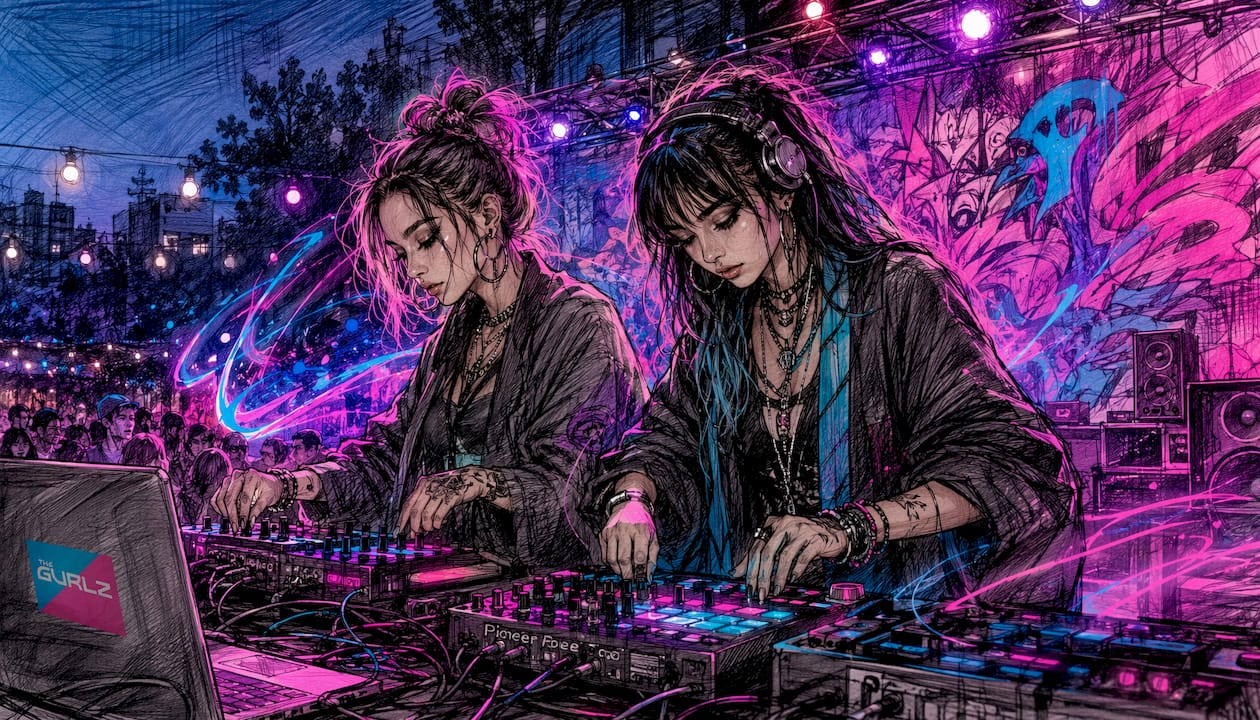
They started with Bass & Breakz at Sunset Cliffs, an immersive audio-visual DJ set that set the format. Location-specific. Visually driven. Mixed live. House in the Wild continues that format, pushing it further.
What makes THE GURLZ different:
- Every set is produced, filmed, mixed, and edited by Desi and Angelina
- The visuals are not generic. They come from the specific place and time of the set
- Their sound moves through drum and bass, breakbeats, halftime, house, and tribal, shifting with the set
- They are a queer, married couple working in a space that has historically been dominated by men
- Originally based in Denver, CO, a city with one of the strongest bass music communities in the US
Upcoming: Original music from their studio is in progress, along with more audio-visual sets already in motion.
Pro Tip: Watch their sets on YouTube before you listen on SoundCloud. The visual layer changes how the music lands.
THE GURLZ are for adults. The energy is bold, colorful, and unapologetic. If you are into van life, travel, beach locations, multi-genre sets, and a queer creative perspective on bass music, this is the project to follow.
IG: @thegurlzmusic, main social for behind-the-scenes and exclusive content
TikTok: @thegurlzofficial
Youtube: @TheGurlzOfficial
SoundCloud: https://soundcloud.com/thegurlz
www.thegurlzofficial.com
How has DnB shaped music culture beyond the dancefloor?
Drum and bass did not stay contained to clubs and raves. It spread into film soundtracks, video game scores, advertising, and the DNA of genres that came after it. Dubstep, UK garage, and grime all carry DnB’s fingerprints, particularly in how they handle bass and rhythm. The genre’s influence on dubstep is especially direct, with many early dubstep producers coming out of the DnB scene.
In gaming, DnB-influenced soundtracks became a staple of racing and action games through the late 1990s and 2000s. The tempo and tension of the music matched the pace of gameplay in a way few other genres could. Films and TV shows used DnB to signal urgency, speed, or urban grit, often without audiences realizing what they were hearing.
Culturally, DnB has always carried a specific identity. It grew out of Black British culture, deeply connected to Jamaican sound system traditions and the multicultural communities of London. That heritage shapes the genre’s values around community, underground credibility, and resistance to mainstream dilution. The rave culture that birthed DnB was also one of the first spaces in UK youth culture where race, class, and background mixed freely on the dancefloor.
The underground electronic music ethos that DnB carries has influenced how artists across bass music think about independence, label ownership, and direct connection with their audience.
What DnB events and festivals happen in the US?
The US DnB scene is smaller than the UK’s but active, particularly in cities with strong bass music communities. Denver, Los Angeles, San Francisco, New York, and Chicago all have regular DnB nights, ranging from intimate club events to larger festival stages.
Festival presence:
- Bass-focused festivals like Shambhala (Canada, but draws heavily from US audiences), Gem and Jam, and Sonic Bloom regularly feature DnB artists on their lineups. These events attract the same crowd that follows DnB in the US and often serve as the best live introduction to the genre for American fans.
- Electric Forest and Dirtybird Campout have featured DnB-adjacent programming, reflecting the genre’s crossover appeal with the broader bass music community.
Club nights and local scenes:
- Denver’s bass music scene, where THE GURLZ are rooted, is one of the most active in the country. Local promoters run regular DnB nights that bring in both domestic and international artists.
- Los Angeles and New York have long-running DnB nights that have hosted artists like Chase & Status, Pendulum, and High Contrast on US tours.
- San Francisco’s underground scene has supported DnB since the late 1990s, with a dedicated community that keeps the genre alive between major tours.
For festival-goers new to DnB, a live set is the fastest way to understand what the genre does that a playlist cannot replicate. The bass at volume, the crowd locked into the rhythm, the way a DJ builds and releases tension over an hour: that is the full experience. If you want to dress the part, festival streetwear built for bass music events, like the kind found at EDM-focused rave apparel shops, fits the energy of these events well.
Key Takeaways
Drum and bass is a 165–185 BPM electronic genre rooted in UK rave culture, defined by breakbeats, heavy sub-bass, and a rich subgenre ecosystem that spans melodic liquid to aggressive neurofunk.
| Point | Details |
|---|---|
| Core tempo and sound | DnB runs at 165–185 BPM with syncopated breakbeats and heavy sub-bass as its defining features. |
| Historical roots | The genre emerged from the UK rave and jungle scenes of the early 1990s, drawing on reggae, dub, and hip-hop. |
| Subgenre diversity | Liquid, neurofunk, jump-up, and techstep each offer a distinct mood and energy for different listening contexts. |
| US discovery | UKF, Liquicity, and DnB Allstars on Spotify and YouTube are the best starting points for US listeners. |
| THE GURLZ innovation | THE GURLZ produce, film, mix, and edit their own audio-visual DnB sets, building a visual world around each live mix. |
FAQ
What does DnB mean in music?
DnB stands for drum and bass, an electronic dance music genre characterized by fast breakbeats at 165–185 BPM, heavy sub-bass lines, and complex syncopated rhythms. It originated in the UK in the early 1990s.
Is DnB a form of EDM?
Yes. Drum and bass is a subgenre of electronic dance music, though it has a distinct identity and culture separate from mainstream EDM styles like house or trance. It sits closer to the underground end of the electronic music spectrum.
Who is the biggest DnB artist?
Goldie, Roni Size, and Chase & Status are among the most recognized names in drum and bass history. Chase & Status reached UK No. 1 in 2024 with “BACKBONE” featuring Stormzy, making them one of the genre’s most commercially successful acts.
What is the most famous DnB song?
DJ Fresh’s “Hot Right Now” featuring Rita Ora became the first DnB track to hit UK No. 1 in 2012 and remains one of the genre’s most widely heard songs. Pendulum’s catalog, particularly tracks from Hold Your Colour, also ranks among the most recognized DnB music globally.
How is DnB different from jungle music?
Jungle is the direct predecessor to drum and bass, sharing the breakbeat structure and reggae-influenced basslines. DnB stripped away some of jungle’s ragga and vocal elements, pushing the tempo higher and the bass deeper, creating a cleaner and more intense sound.
Recommended
- Why DnB Is Popular with Female Dancers in 2026 – ☀︎THE GURLZ ☽ – WIFEY DJ DUO / ARTISTS / PRODUCERS
- What Is Rolling Bass in DnB: A Producer’s Guide – ☀︎THE GURLZ ☽ – WIFEY DJ DUO / ARTISTS / PRODUCERS
- Bass Music Production Styles Compared: 2026 Guide – ☀︎THE GURLZ ☽ – WIFEY DJ DUO / ARTISTS / PRODUCERS
- Sidebar Main – ☀︎THE GURLZ ☽ – WIFEY DJ DUO / ARTISTS / PRODUCERS


