
TL;DR:
- BPM, or beats per minute, shapes the emotional and physical experience of dance music and influences crowd movement. DJs use BPM to craft a physiological journey by arcing tempo throughout their sets, aligning with energy levels and crowd responses. The right BPM range maximizes dance participation, with 118–128 BPM being the most effective for engagement.
BPM, or beats per minute, is the primary measure of tempo in music, and the role of BPM in dance music goes far beyond counting beats. It shapes how your body responds, how a crowd moves, and how a DJ controls the energy in a room. The 118–128 BPM sweet spot is where most dance floors hit peak participation, balancing natural movement with sustained engagement. Understanding tempo means understanding why certain tracks make you move before you even realize it.
How does BPM shape the emotional and physical experience of dance?
Tempo is often the first emotional signal in music, arriving before melody or lyrics register. Your brain reads speed and responds before conscious thought kicks in.
A 1,280-participant study found that higher tempos evoke vitality and arousal, while slower tempos produce calmness and introspection. That finding explains why a 170 BPM drum and bass track feels urgent and physical, while a 90 BPM downtempo groove feels like it slows the whole room down.
The physical effects are measurable. Music at 120–140 BPM correlates with increased heart rate and global arousal, triggering instinctive movement. At 120 BPM, two beats hit every second, which aligns closely with natural walking and movement rhythms.
Matching tempo to movement also reduces physical effort. Music tempo matched to movement reduces exertion by 8–12% and increases dance endurance by 15%. That means the right BPM does not just feel better. It actually lets you dance longer.
- Tempos below 100 BPM feel slow, introspective, and grounding
- 100–118 BPM builds anticipation and warms up the body
- 118–128 BPM hits the peak participation zone for most dancers
- 128–145 BPM drives high-intensity movement and sustained cardio energy
- Above 160 BPM pushes into athletic territory, best used in short bursts
Pro Tip: Match your playlist BPM to the physical intensity you want from the room. Starting too high burns dancers out early. Starting low and building gives the crowd somewhere to go.
What BPM ranges define the major dance music genres?
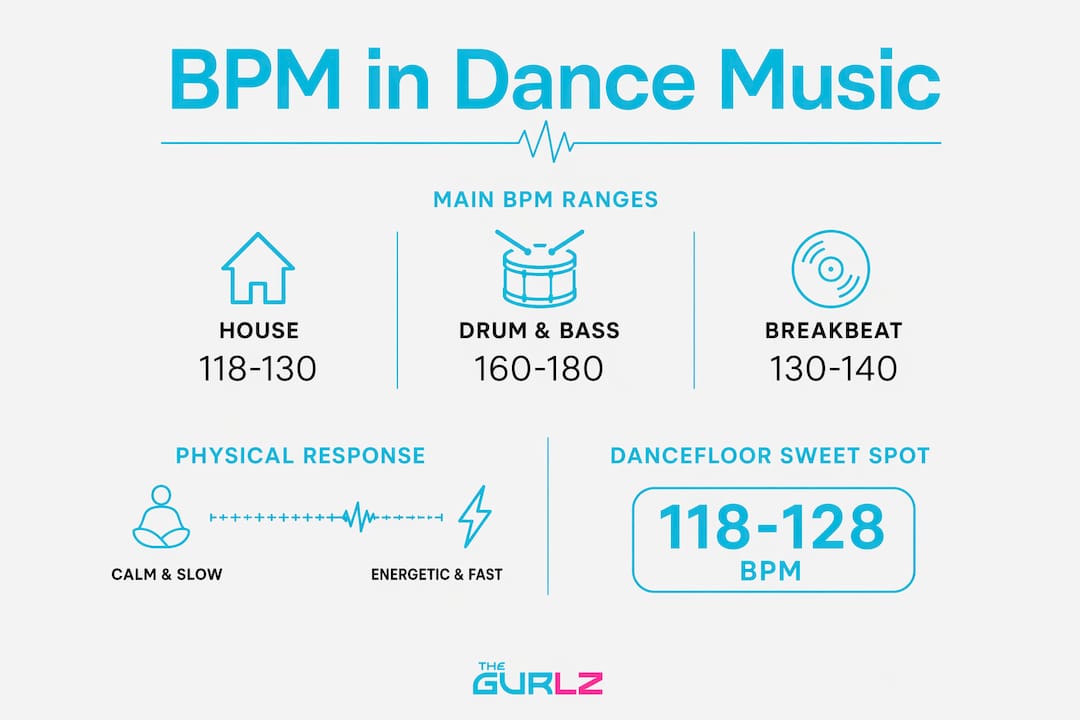
Genre identity in electronic music is built partly on tempo. Each genre occupies a BPM range that shapes its feel, its crowd, and its culture.
| Genre | Typical BPM Range | Feel |
|---|---|---|
| House | 118–130 BPM | Groove-driven, steady, hypnotic |
| Techno | 120–145 BPM | Mechanical, driving, relentless |
| Drum & Bass | 170–178 BPM | Fast, kinetic, high-pressure |
| Halftime | 85–95 BPM | Heavy, slow-rolling, bass-forward |
| Breakbeats | 110–140 BPM | Syncopated, funky, unpredictable |
| Tribal | 120–135 BPM | Percussive, hypnotic, ritualistic |
BPM alone does not define a genre. Two tracks at the same BPM can feel completely different based on rhythm, groove, percussion density, and backbeat placement. Dubstep and techno both sit around 140 BPM, but they occupy entirely different sonic and emotional spaces.
Halftime is the clearest example of this principle. Drum and bass tracks often run at 170 BPM, but a halftime groove inside that same track makes the body feel like it is moving at 85 BPM. The number stays the same. The feel changes entirely.
This is why experienced DJs treat BPM as a flexible reference point rather than a fixed rule. Half-time and double-time feels allow contrast and flexibility that the raw number cannot capture. THE GURLZ move through drum and bass, breakbeats, house, and halftime in a single set, using these tempo relationships to shift energy without losing the crowd.
How do DJs use BPM to control the dancefloor?
BPM is the structural grid of a DJ set. Every transition, every effect, every build depends on it. DJs arc BPMs throughout sets, starting lower, building through the middle, and managing the crowd’s physical state in real time. That arc is not accidental. It mirrors how the body responds to sustained physical activity.
A set that opens at 120 BPM and climbs to 140 BPM over two hours creates a physiological journey. The crowd’s heart rate follows the tempo. Energy peaks when the BPM does. Experienced DJs use this relationship to control mood as precisely as any lighting or visual cue.
BPM also governs production decisions inside the mix. Failing to align effects to the BPM grid causes phase issues and muddy mixes. Snapping delay and reverb to the tempo grid keeps the sound clean and club-ready. Amateur mixes often fall apart here, not because of track selection, but because the effects drift out of sync with the beat.
Pro Tip: Snap every effect, including delay, reverb, and filter sweeps, to the BPM grid. Even subtle misalignment creates tension that the crowd feels before they can name it.
Rhythm and groove carry as much weight as the tempo number itself. BPM doesn’t solely define energy. Rhythmic structure, percussion density, and groove shape how a track actually feels at any given tempo. A skilled DJ reads both the number and the feel, adjusting the mix accordingly.
How do dancers respond to BPM, and why does it matter for curation?
Dancers respond most freely in the moderate tempo zone. The 118–128 BPM range maximizes floor participation because it aligns with natural movement comfort. Below that range, movement feels effortful. Above it, sustained dancing becomes physically demanding.
For dance-fitness applications, BPM selection maps directly to workout phases. Warm-ups run at 90–110 BPM. Cardio phases push into 128–140 BPM. HIIT spikes reach 140–160 BPM, with 180 BPM reserved for brief athletic bursts. The same logic applies to DJ sets, even outside a fitness context. The body has limits, and BPM-aware curation respects them.
Producers and DJs who understand this build sets with intention. They do not just play tracks they like. They sequence tempo to guide physical experience. Here is how that thinking applies in practice:
- Open with 110–118 BPM to warm the room without overwhelming early arrivals
- Build into 120–128 BPM for the main floor energy peak
- Use 128–140 BPM for peak-hour intensity when the crowd is fully engaged
- Drop back to lower tempos or halftime feels to give dancers a physical reset
- Close with a tempo that matches the emotional tone you want to leave behind
THE GURLZ apply this approach across their bass music sets, moving through drum and bass, breakbeats, and house in a single session. The BPM shifts are not random. They follow the energy of the location, the time of day, and the crowd in front of them. Every set is mixed live, and the tempo arc is built in real time.
Key Takeaways
BPM is the structural foundation of dance music, and matching tempo to dancer physiology is the single most direct way to control floor energy and crowd engagement.
| Point | Details |
|---|---|
| Sweet spot for participation | 118–128 BPM maximizes dance floor engagement and natural movement comfort. |
| Tempo as emotional signal | Higher BPMs trigger arousal and vitality; lower BPMs produce calm and introspection. |
| BPM is not genre alone | Groove, rhythm, and percussion shape feel as much as the tempo number itself. |
| DJs arc BPM intentionally | Building from low to high BPM across a set mirrors and drives crowd physiology. |
| Curation requires tempo mapping | Sequencing BPM by phase, from warm-up through peak to close, shapes the full experience. |
BPM, visuals, and the live set: a perspective from THE GURLZ
Every set Desi and Angelina build starts with a feel, and that feel is almost always anchored to a tempo range. The BPM is not just a number on a screen. It is the pulse the visuals follow, the rhythm the edit cuts to, and the energy the crowd locks into.
What most people miss is how much BPM shapes the visual experience of a set. When the tempo drops into halftime territory, the edit slows. The cuts breathe. The color holds longer. When the BPM climbs into drum and bass range, the visuals tighten. Movement and texture hit faster. The whole sensory experience accelerates together.
THE GURLZ built Bass & Breakz at Sunset Cliffs around this relationship. The location, the light, and the tempo all moved together. House in the Wild does the same thing at a different speed. The BPM changes. The approach does not.
The uncomfortable truth about tempo is that most people feel it without knowing it. They say a set had great energy, or the vibe was off, without realizing that BPM was the variable that shifted. Understanding original bass electronic music means understanding that tempo is never neutral. Every number is a choice, and every choice has a physical consequence on the floor.
— THE GURLZ OFFICIAL
THE GURLZ sets: BPM in motion
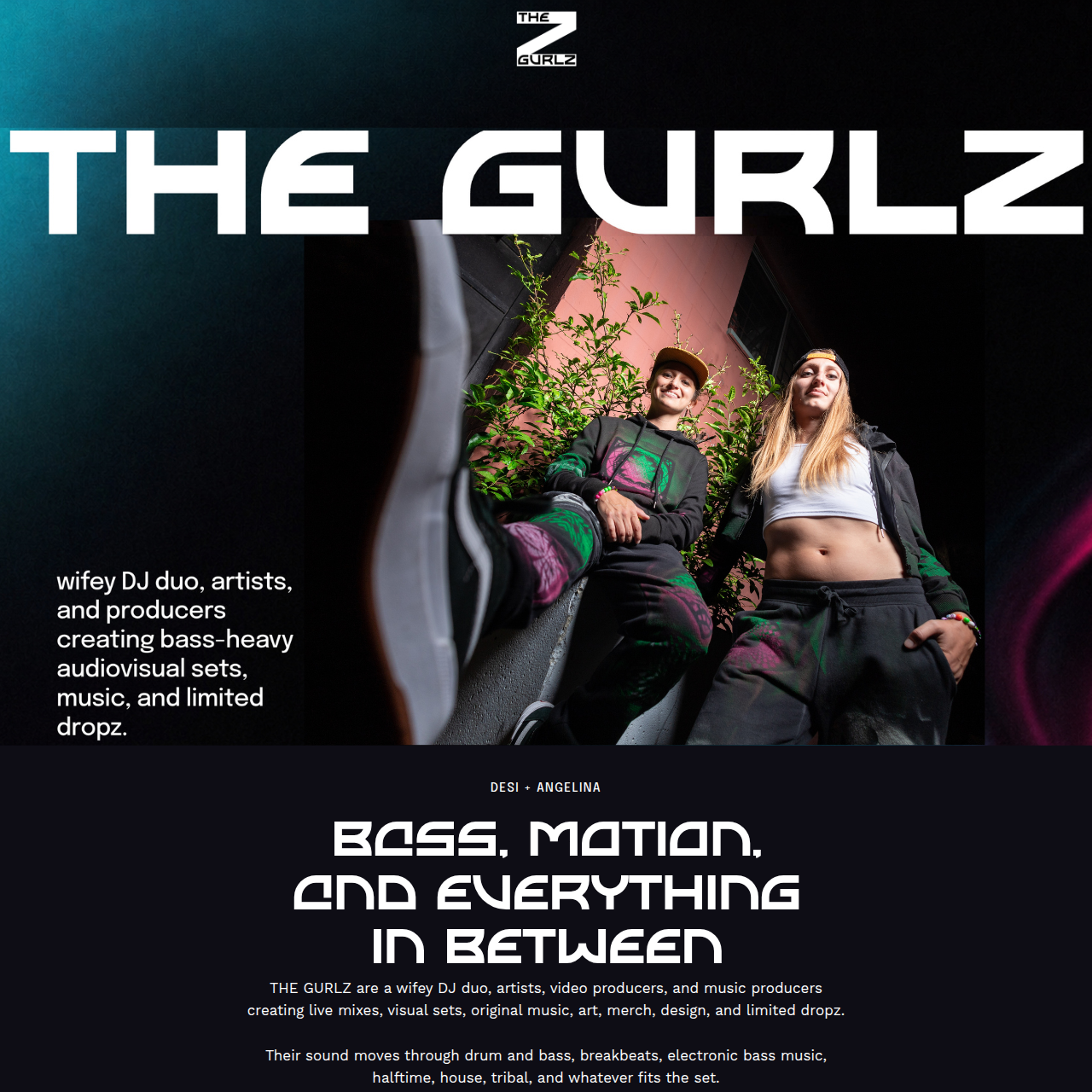
THE GURLZ build every set around tempo with intention. Desi and Angelina move through drum and bass, breakbeats, halftime, and house, using BPM shifts to shape the energy of each location and moment. The music is mixed live. The visuals follow the beat. Nothing is pre-packaged.
Each audio-visual set, from Bass & Breakz at Sunset Cliffs to House in the Wild, is produced, filmed, and edited entirely by THE GURLZ. The full set experience lives at their official site, where new setz, original music, and limited drops continue to roll out. If you want to feel what BPM-driven curation actually looks and sounds like, this is where it lives.
IG: @thegurlzmusic, main social for behind-the-scenes and exclusive content
TikTok: @thegurlzofficial
Youtube: @TheGurlzOfficial
SoundCloud: https://soundcloud.com/thegurlz
www.thegurlzofficial.com
FAQ
What is BPM in dance music?
BPM stands for beats per minute, the standard measure of tempo in music. It defines how fast a track moves and directly shapes how dancers respond physically and emotionally.
What BPM is best for dancing?
The 118–128 BPM range produces the highest dance floor participation by aligning with natural movement rhythms and balancing energy with endurance.
Why do two tracks at the same BPM feel different?
Groove, percussion density, and backbeat placement change how a tempo feels in the body. Dubstep and techno both sit near 140 BPM but create entirely different physical and emotional responses.
How do DJs use BPM to manage crowd energy?
DJs arc BPMs across a set, starting lower and building higher, to mirror and drive the crowd’s physical state. This progression controls heart rate, energy peaks, and the emotional arc of the night.
What BPM does drum and bass use?
Drum and bass typically runs at 170–178 BPM. Halftime grooves within that range create a felt tempo closer to 85–95 BPM, giving the genre its heavy, slow-rolling character despite its fast technical speed.
Recommended
- Bass Music Tempos for Dancers: The Complete BPM Guide – ☀︎THE GURLZ ☽ – WIFEY DJ DUO / ARTISTS / PRODUCERS
- Women DJs Breaking Bass Music Barriers: Who to Know – ☀︎THE GURLZ ☽ – WIFEY DJ DUO / ARTISTS / PRODUCERS
- Footer – Dark [Festival] – ☀︎THE GURLZ ☽ – WIFEY DJ DUO / ARTISTS / PRODUCERS
- How to Find Original Bass Electronic Music – ☀︎THE GURLZ ☽ – WIFEY DJ DUO / ARTISTS / PRODUCERS


