
The strongest vexra.events alternatives for US event organizers are Cvent, Bizzabo, Whova, EventsAir, Accelevents, Eventbrite, Webex Suite, Hubilo, Eventsquid, EventMobi, 6Connex, Zuddl, Boomset, Bevy, and InEvent. Each covers a different slice of the virtual and hybrid event market, from enterprise-grade conference platforms to community-first tools built for grassroots organizers. The table below maps the core differences at a glance.
| Platform | Best For | Core Features | Mobile App | Scalability | Unique Differentiator |
|---|---|---|---|---|---|
| EventsAir | Large conferences, trade shows | Registration, agenda, virtual rooms | Yes | High | Immersive virtual environments |
| Accelevents | Fundraisers, hybrid conferences | Ticketing, fundraising, sponsorship | Yes | Medium–High | Integrated fundraising tools |
| Eventbrite | All event types, local and commercial | Ticketing, discovery, email marketing | Yes | High | Broad event discovery marketplace |
| Whova | Networking-heavy conferences, expos | Agenda, networking, attendee chat | Yes | Medium–High | Attendee engagement and agenda tools |
| Cvent | Large corporations, high-volume events | Full event lifecycle, analytics, CRM | Yes | Very High | Deep analytics and enterprise integrations |
| Bizzabo | Corporate conferences, marketing events | Event marketing suite, analytics | Yes | High | Marketing suite and event analytics |
| Webex Suite | Virtual meetings, webinars | Webcast, collaboration, security | Yes | High | Reliable webcast and communication tools |
| Hubilo | Interactive virtual conferences | Engagement tools, gamification | Yes | Medium–High | Gamified attendee engagement |
| Eventsquid | Associations, membership organizations | Registration, group management, check-in | Yes | Medium | Customizable registration and group tools |
| EventMobi | Hybrid events, conferences | Event app, engagement analytics | Yes | Medium–High | Mobile app customization |
| 6Connex | Trade shows, multi-track conferences | 3D environments, multi-session support | Yes | High | Immersive 3D virtual spaces |
| Zuddl | B2B events, expos | Networking, lead capture, content delivery | Yes | Medium–High | Rich networking and lead capture |
| Boomset | Hybrid events, onsite check-in | Badge printing, check-in, virtual extension | Yes | Medium | Onsite and virtual integration |
| Bevy | Community-centered organizations | Community management, event tools | Yes | High | Scalable community management |
| InEvent | Customer engagement, corporate events | Analytics dashboard, CX tools | Yes | High | Strong analytics and customer experience |
Quick standouts worth noting before going deeper: Cvent leads on enterprise depth, Whova on attendee networking, 6Connex on visual immersion, and Accelevents on fundraising. Eventbrite’s discovery marketplace is unmatched for reaching new audiences, though it comes with per-ticket fees that add up fast.
What do the top vexra.events alternatives actually offer?
Platform capabilities vary more than the marketing suggests. Knowing what each tool does well at the feature level saves a lot of painful mid-planning pivots.

Registration and ticketing are table stakes, but the execution differs. Eventsquid gives associations fine-grained control over group registrations and membership tiers. Eventbrite keeps ticketing dead simple for organizers who need speed over customization. Accelevents layers fundraising and donation tools directly into the ticket flow, which is rare.
Attendee and speaker management is where Whova and EventMobi pull ahead of the pack. Whova’s agenda builder lets attendees build personal schedules and message each other before the event even starts. EventMobi’s mobile app puts speaker bios, session ratings, and live Q&A in one place, with engagement analytics that show exactly which sessions held attention.
Networking tools split into two camps. Zuddl and Hubilo lean into structured networking: AI-powered matchmaking, virtual lounges, and gamified interaction points. Bizzabo and Cvent take a more data-driven approach, connecting networking activity back to CRM records and marketing attribution. For organizers running B2B events where every conversation is a potential lead, that CRM loop matters.
Sponsorship and exhibitor management is a genuine differentiator for Accelevents and 6Connex. Accelevents builds sponsor tiers, branded booths, and lead capture directly into the platform. 6Connex goes further with 3D virtual exhibit halls where sponsors get branded environments, not just a logo placement.
On integrations, Cvent and Bizzabo connect natively with Salesforce, HubSpot, Marketo, and most major marketing automation tools. Webex Suite plugs into the broader Cisco collaboration stack, making it the natural choice for organizations already running Webex for internal meetings. Boomset handles the onsite side, syncing badge printing and check-in data back to the virtual event layer.
- Cvent and Bizzabo: deepest CRM and marketing automation integrations
- Whova and EventMobi: strongest mobile-first attendee experience
- 6Connex and Hubilo: most immersive virtual environments
- Accelevents: best built-in fundraising and sponsor management
- Boomset: best onsite-to-virtual continuity for hybrid events
- Bevy: best for recurring community events across multiple chapters
- InEvent: strongest analytics dashboard for post-event reporting
Customer support quality also varies. Cvent and InEvent offer dedicated account management at enterprise tiers. Eventsquid and Accelevents are known for responsive support at mid-market price points. Webex Suite leans on Cisco’s global support infrastructure.
How do pricing models and scalability compare across platforms?
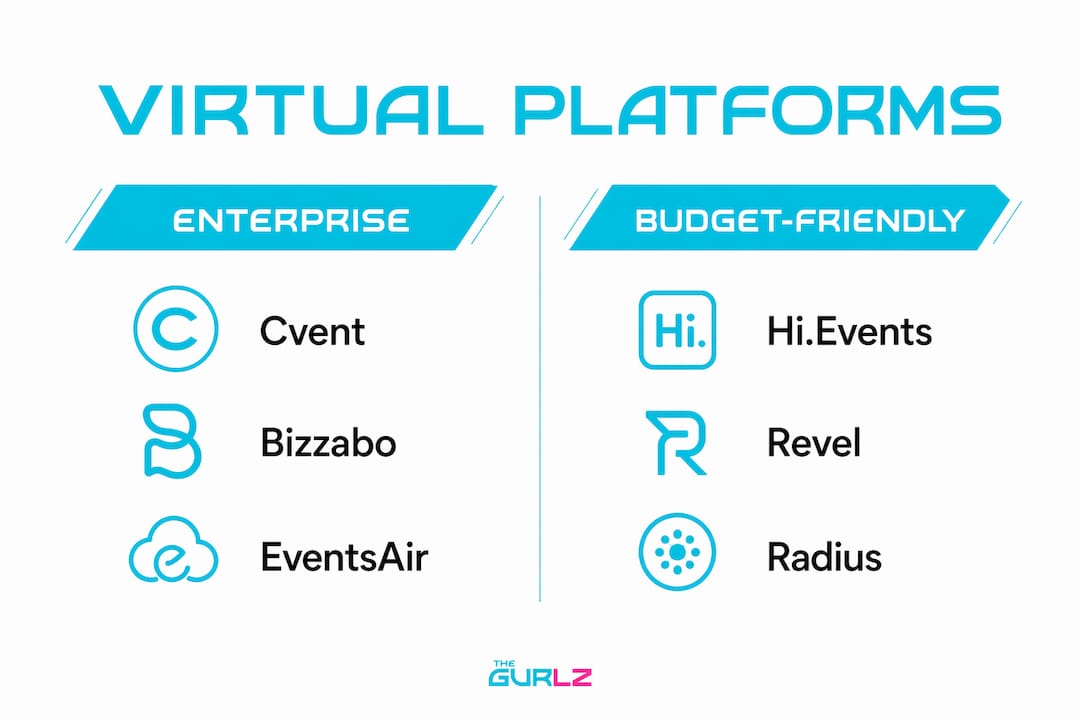
Pricing structures across these platforms fall into four broad models: per-ticket fees, monthly or annual subscriptions, custom enterprise contracts, and free tiers with paid upgrades.
Eventbrite charges around 3.7% plus fees per ticket, which works fine for occasional events but compounds quickly for high-volume organizers. Cvent, Bizzabo, and InEvent operate on annual enterprise contracts with pricing negotiated by event volume and feature set. Neither publishes a public rate card. Accelevents and Hubilo offer tiered subscription plans, with pricing scaling by attendee capacity and feature access. Eventsquid and EventMobi publish tiered plans aimed at associations and mid-market event teams.
Bevy and Whova sit in the mid-market range, with Bevy’s pricing structured around community size and event frequency. Boomset charges per device for onsite hardware integrations, which can surprise organizers who underestimate their check-in station count. Webex Suite pricing ties into Cisco’s broader licensing model, so organizations already paying for Webex Calling or Webex Meetings often get event hosting bundled.
Scalability breaks down cleanly by platform tier:
- Very high capacity: Cvent, Eventbrite, Bizzabo, InEvent handle tens of thousands of attendees across multi-track programs
- High capacity: EventsAir, Whova, 6Connex, Hubilo, Bevy scale well for conferences in the thousands
- Medium capacity: Accelevents, EventMobi, Zuddl, Eventsquid suit events from hundreds to a few thousand
- Onsite-focused: Boomset scales by hardware deployment, not attendee count
For virtual and hybrid events specifically, 6Connex and EventsAir handle multi-session, multi-track programs with concurrent streams. Zuddl and Hubilo are built for interactive virtual formats where attendee engagement per session matters more than raw headcount.
Pro Tip: Before committing to any subscription plan, ask the vendor for a written breakdown of what happens to your attendee data if you cancel. Platforms that make data export difficult or charge for it are effectively holding your audience hostage. Full CSV export with email addresses should be a baseline requirement, not a premium feature.
How to choose the best vexra.events alternative for your event
The right platform depends on four things: event type, audience size, budget, and how much control you need over your attendee data.
Start with event type. A corporate conference with 2,000 registered attendees and a sponsor hall needs something different from a community meetup with 80 people. Cvent and EventsAir are built for the former. Bevy and Eventsquid fit the latter. Hybrid events with both in-person and virtual tracks need a platform that handles both sides without duct tape, which points to Boomset, EventMobi, or EventsAir.

Audience size shapes the budget conversation fast. Per-ticket fee models like Eventbrite’s look cheap at small scale but get expensive above a few hundred paid tickets. Subscription models from Accelevents or Hubilo become cost-effective once you’re running multiple events per year. Enterprise contracts from Cvent or Bizzabo only make sense when event volume justifies the annual commitment.
Feature requirements narrow the field further. If attendee networking is the core value of your event, Whova and Zuddl are hard to beat. If post-event analytics and CRM attribution matter, Bizzabo and InEvent are the cleaner choices. If you need a built-in event discovery audience, Eventbrite’s promotional tools are a genuine asset that self-hosted alternatives cannot replicate.
Data ownership is the factor most organizers underweight until it’s too late. Losing historical attendee data when switching platforms is a real operational risk. Prioritize platforms that let you export your full attendee list, including email addresses, at any time without restriction.
- Confirm full data export is available before signing any contract
- Test the mobile app on both iOS and Android before committing
- Request a live demo with your actual event format, not a generic walkthrough
- Ask about uptime SLAs for live event days specifically
- Check whether customer support is available during your event’s time zone
Which platforms offer trials or demos worth your time?
Most platforms in this category offer some form of demo or trial access, but the quality varies considerably.
Eventbrite requires no trial at all. You can create a free event and experience the full organizer workflow immediately. Whova, Accelevents, and EventMobi offer guided demos on request, typically a 30-minute walkthrough with a sales rep. The more useful approach is to ask for a sandbox environment where you can build a test event yourself. Cvent and Bizzabo demos are sales-led and require a discovery call first, which is standard at the enterprise tier.
Hubilo and Zuddl offer self-serve trial access for smaller event formats. 6Connex demos focus heavily on the 3D environment builder, which is worth seeing live before you commit. Boomset lets you test the check-in hardware workflow with a demo kit if you’re evaluating onsite integration. InEvent’s demo process is thorough and includes a walkthrough of the analytics dashboard, which is one of its strongest features.
The evaluation criteria that matter most during a trial: how long it takes to build a basic registration page, whether the mobile app works without a tutorial, and how attendee data exports are structured. A platform that takes three hours to configure for a simple event will take three days for a complex one.
How this list was built
Every platform on this list was evaluated against a consistent set of criteria, with no vendor input into the final rankings or descriptions.
The evaluation covered feature completeness across registration, ticketing, attendee management, networking, sponsorship, integrations, and mobile support. Pricing transparency was assessed based on publicly available information and, where pricing is not public, noted as such. User reviews from Capterra and similar independent review platforms informed the assessment of real-world reliability and support quality. Scalability was evaluated based on documented attendee capacity and multi-session support. Market availability was confirmed for the US market specifically.
- Feature completeness across the full event lifecycle
- Pricing transparency and total cost of ownership
- Independent user reviews from verified sources
- Scalability for virtual, hybrid, and in-person formats
- Mobile app quality on both major operating systems
- Integration depth with CRM and marketing tools
- Customer support responsiveness and availability
No platform paid for inclusion. Platforms were excluded if they lacked sufficient independent review data, were not available in the US market, or could not be verified as actively maintained in 2026.
Specialized low-fee alternatives for budget-conscious organizers
The platforms above are built for professional event teams with real budgets. For grassroots organizers, electronic music promoters, and community builders, a different tier of tools makes more sense financially.
Hi.Events charges just 0.75% plus $0.40 per ticket, which is up to 85% lower than traditional platforms. On a $30 ticket, that’s substantially less than platforms charging higher fees. For club nights and festival promoters managing tight margins, that difference goes directly toward artist fees or production. Hi.Events also offers instant payouts via Stripe, so promoters get paid when tickets sell rather than waiting until after the event. A self-hosted version is available under the AGPL license with zero platform fees.
Revel takes a similar approach for community organizers. Its hosted version charges 1.5% plus €0.25 per paid ticket, and self-hosting is completely free. Revel is MIT-licensed and built with full data ownership as a design principle, not an afterthought. Compared to Eventbrite’s fee structure, Revel lowers fee costs by up to 60%. It covers ticketing, RSVPs, attendee management, and QR code check-in, which covers most community event needs without the overhead of an enterprise platform.
Radius is free for groups up to 50 members, with no per-ticket fees or payment gateway charges. It’s built for recurring community events, neighborhood classes, and pop-up shows where the goal is growing a community over time, not maximizing ticket revenue. The trade-off is limited discovery reach compared to Eventbrite.
For organizers who want complete control, self-hosted options like Pretix offer zero platform fees and full data ownership. Pretix handles multi-day events, reserved seating, discount codes, and mobile check-in via its pretixSCAN app. The cost is real technical overhead: Docker setup, server management, and handling your own payment processing through Stripe. That’s a reasonable trade for organizations with technical staff and a long-term event calendar.
- Hi.Events: best for electronic music and club nights needing low fees and instant payouts
- Revel: best for community organizers wanting open-source transparency and data control
- Radius: best for small recurring groups under 50 members with no ticketing budget
- Pretix: best for technically capable teams wanting zero platform fees and full ownership
Switching to a lower-fee platform frees up real money. For electronic music promoters specifically, that budget shift often goes toward better audio equipment, stronger artist bookings, or production quality that the audience actually feels. Check out festival event alternatives for more context on how fee structures affect event production decisions.
THE GURLZ: a different kind of event experience
Event platforms handle logistics. THE GURLZ handle the part that actually stays with people.
Desi and Angelina are a wifey DJ duo, artists, and producers who create immersive audiovisual DJ sets that are produced, filmed, mixed, and edited entirely in-house. The music is mixed live. The visuals come from the location itself, the light, the movement, the texture of wherever the set is happening. Bass & Breakz at Sunset Cliffs started the format. House in the Wild continues it.

THE GURLZ are not a platform. They’re the experience that a platform is supposed to host. For event organizers building something with a real visual identity, original music, and an audience that wants more than a registration link, THE GURLZ offer a different kind of collaboration.
What THE GURLZ create and release:
- Live audiovisual DJ sets filmed and edited at specific locations
- Original music spanning drum and bass, breakbeats, halftime, house, and tribal
- Limited merchandise drops and design work
- Visual sets built around the music, not layered on top of it
Original music from their studio is in motion. More audiovisual sets are already being built. The format keeps moving.
IG: @thegurlzmusic, main social for behind-the-scenes and exclusive content
TikTok: @thegurlzofficial
Youtube: @TheGurlzOfficial
SoundCloud: https://soundcloud.com/thegurlz
www.thegurlzofficial.com
FAQ
What are the best virtual event platforms in 2026?
Cvent, Bizzabo, Whova, and EventsAir lead for professional virtual and hybrid events, with Cvent offering the deepest enterprise feature set and Whova excelling at attendee networking. For smaller or community-focused events, Accelevents and EventMobi offer strong value at lower price points.
What is a virtual event platform?
A virtual event platform is software that hosts online or hybrid events, handling registration, ticketing, live streaming, attendee networking, and post-event analytics in one system. The best platforms also integrate with CRM and marketing tools to connect event data to broader audience management.
How do vexra.events alternatives handle attendee data ownership?
Most enterprise platforms like Cvent and Bizzabo allow full data export, but organizers should confirm this in writing before signing. Open-source options like Pretix and Revel are built around full data ownership by design, with no platform restrictions on exporting attendee records.
Which platform is best for electronic music and club events?
Hi.Events is built specifically for this use case, charging 0.75% plus $0.40 per ticket with instant Stripe payouts and a free self-hosted option. For larger festival formats, EventsAir and 6Connex handle the scale, though at significantly higher cost.
Do any vexra.events alternatives offer free tiers?
Radius is free for communities up to 50 members with no per-ticket fees. Revel’s self-hosted version is completely free. Eventbrite is free for free events. Most enterprise platforms like Cvent and Bizzabo do not offer free tiers.
Key Takeaways
The strongest vexra.events alternatives combine feature depth, transparent pricing, and full attendee data ownership — no single platform wins on all three, so the right choice depends on your event type and scale.
| Point | Details |
|---|---|
| Enterprise vs. community tools | Cvent and Bizzabo suit large corporate events; Radius and Revel fit grassroots organizers with no platform budget. |
| Fee structures matter at scale | Eventbrite charges around 3.7% plus fees per ticket; Hi.Events’ fees are up to 85% lower at 0.75% plus $0.40 per ticket, making Hi.Events a top choice for promoters seeking to minimize costs. |
| Data ownership is non-negotiable | Confirm full CSV export with email addresses before signing any platform contract. |
| Open-source options exist | Pretix and Revel offer zero platform fees with self-hosting, at the cost of technical setup and server management. |
| THE GURLZ as experiential complement | For organizers building events with real visual identity, THE GURLZ create live audiovisual DJ sets that go beyond what any platform delivers. |
Recommended
- Top 4 wjuvjs.studio Alternatives for Creative Experts 2026 – ☀︎THE GURLZ ☽ – WIFEY DJ DUO / ARTISTS / PRODUCERS
- Top 5 Conceptone.studio Alternatives in 2026 – ☀︎THE GURLZ ☽ – WIFEY DJ DUO / ARTISTS / PRODUCERS
- Top 6 Clozee.net Alternatives for Immersive Music 2026 – ☀︎THE GURLZ ☽ – WIFEY DJ DUO / ARTISTS / PRODUCERS
- Top 4 s7g.show Alternatives Providers 2026 – ☀︎THE GURLZ ☽ – WIFEY DJ DUO / ARTISTS / PRODUCERS


