
TL;DR:
- A visual set in music is a synchronized audiovisual performance designed to create an immersive experience. The visuals are crafted with intentionality, responding to music and enhancing emotional impact through different technology methods.
A visual set in music is a live or pre-produced audiovisual performance where synchronized visuals and sound combine to create a full sensory experience. The industry term for this practice is audiovisual performance, though “visual set” has become the shorthand used across electronic music culture. These sets go far beyond a DJ playing tracks with a screen in the background. The visuals are part of the performance itself. THE GURLZ, a wifey DJ duo based out of Denver, CO, have built their entire creative identity around this format, filming, mixing, editing, and producing every set themselves.
What is a visual set in music?
A visual set is a performance where music and visuals synchronize in real time or through pre-rendered content to create an immersive experience. The visuals are not decoration. They carry narrative weight, respond to the music, and shape how the audience feels the sound.
The format lives at the intersection of DJing, video production, and live art. A performer might mix tracks live while triggering video clips, generative graphics, or location-filmed footage that follows the energy of the music. The result is something you watch and feel at the same time.
This is distinct from a standard DJ set with a visualizer running in the background. In a true audiovisual performance, the visual layer is authored with the same intention as the music. Every cut, color shift, and texture choice is a creative decision, not an afterthought.
THE GURLZ started this format with Bass & Breakz at Sunset Cliffs, filming the location, mixing the music live, and editing the visuals to follow the set closely. That release defined their approach: music you can watch and feel.
How do visual sets work: technology and synchronization
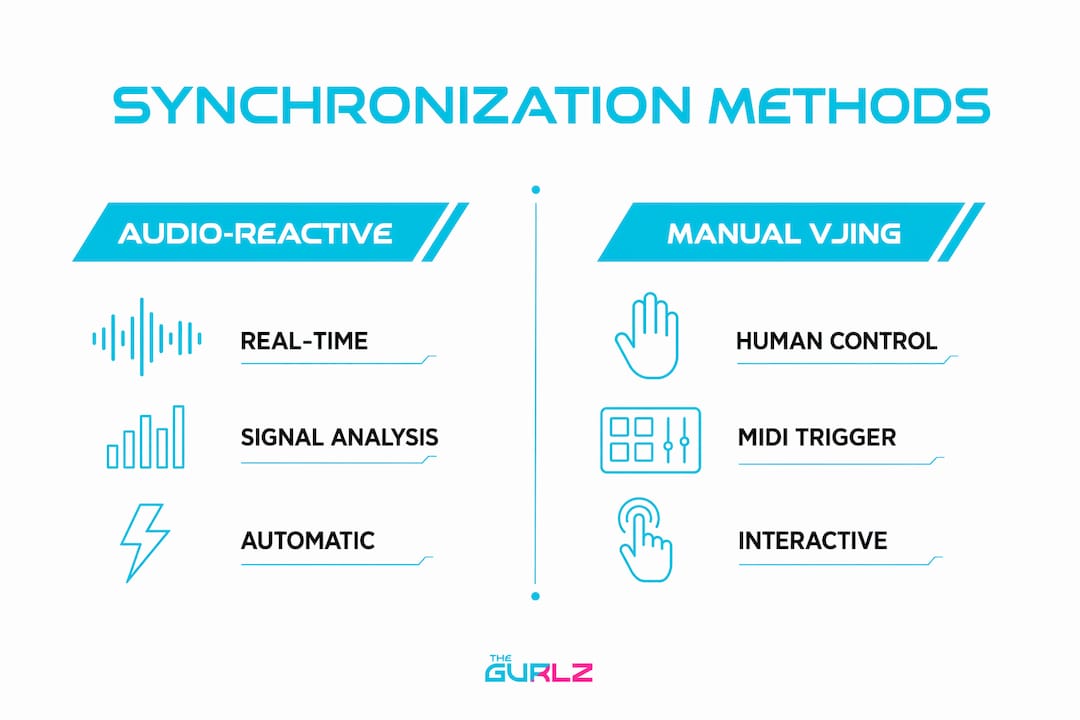
Three main synchronization methods drive visual sets: audio-reactive software, manual trigger-based VJing, and generative 3D visual systems. Each method produces a different feel and requires a different level of technical skill.
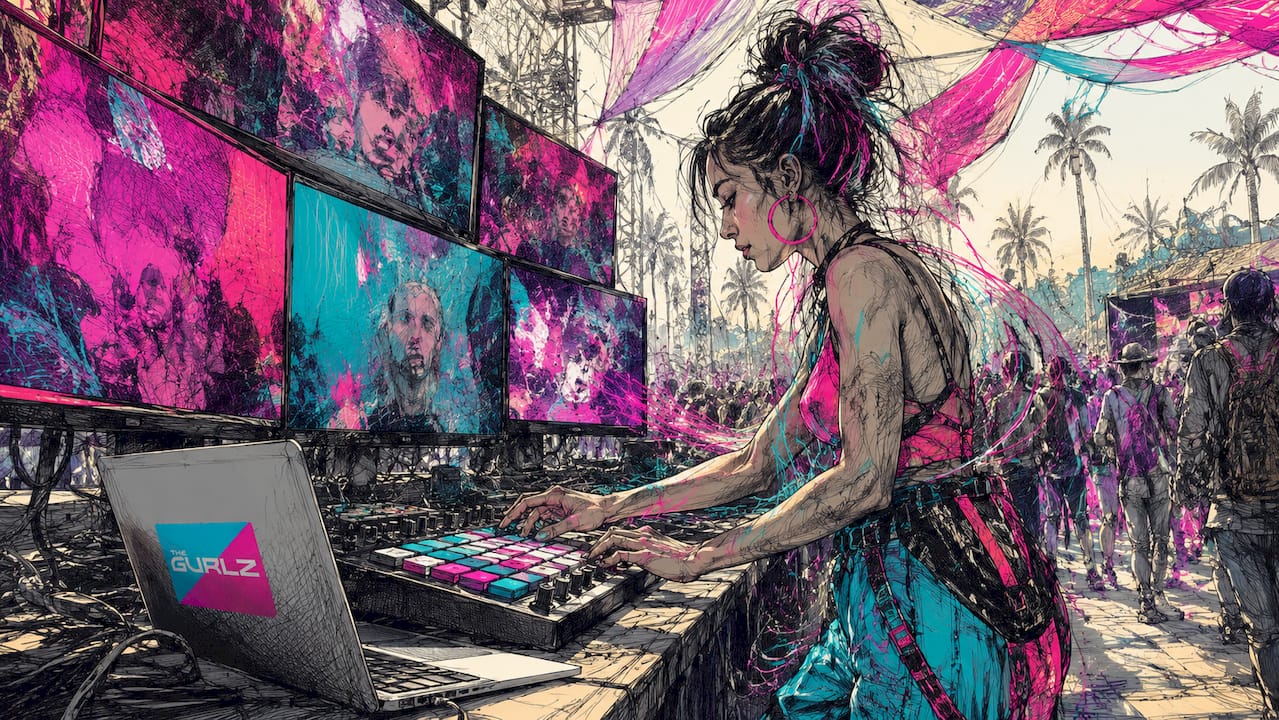
Audio-reactive software
Audio-reactive tools analyze the incoming audio signal in real time. Advanced analyzers detect drum hits, bass frequencies, and spectral information, then drive visual parameters like brightness, scale, and motion speed. The visuals pulse and shift with the music automatically. This approach works well for ambient or continuous sets where the energy stays consistent.
Manual trigger-based VJing
Manual VJing puts a human in control of every visual transition. The performer uses a MIDI controller or keyboard to trigger video clips, switch layers, and adjust effects in sync with the music. This method demands musical awareness and fast reflexes. It also produces the most expressive results because every visual choice is intentional.
Generative 3D systems
Generative systems use software like TouchDesigner to build infinite visual variations controlled by MIDI. Parameters like geometry, color, and motion are mapped to the DJ’s mix changes. This approach sustains visual novelty over long sets without repeating the same loops.
| Synchronization method | Control type | Best use case | Skill level |
|---|---|---|---|
| Audio-reactive software | Automatic | Ambient, continuous sets | Beginner to intermediate |
| Manual trigger VJing | Human-controlled | Expressive live performance | Intermediate to advanced |
| Generative 3D systems | MIDI-mapped automation | Long sets, festival scale | Advanced |
Pro Tip: Balancing automation with manual control prevents visual fatigue. Let the software handle the baseline response, then trigger manual changes at key musical moments for maximum impact.
What is the history behind visual music and visual sets?
Visual music as a formal art form aims to create visual analogues to musical structure, not just react to sound. The term was coined by Roger Fry in 1912. The goal was to make imagery that mirrors the rhythm, phrasing, and emotional arc of music, the way a score mirrors a melody.
Early practitioners treated color and motion as musical instruments. Wassily Kandinsky explored the relationship between sound and visual form in his paintings and writings. Norman McLaren scratched images directly onto film to create animations that moved with the music at a structural level. These were not music videos. They were visual compositions.
The distinction matters. A music visualizer reacts to audio amplitude. True visual music is composed alongside the music, with visual phrases that correspond to musical phrases. That structural thinking is what separates a screensaver from an art form.
Contemporary audiovisual DJ performances carry this tradition into electronic music culture. The format evolved from VJ culture in the 1990s, where video artists performed alongside DJs in clubs. Over time, the two roles merged. Today, many performers handle both the music and the visuals themselves.
Notable contributors to the visual music tradition include:
- Wassily Kandinsky, whose theories on color and sound influenced generations of audiovisual artists
- Norman McLaren, whose hand-drawn film animations synchronized image and sound at a structural level
- Oskar Fischinger, who created abstract animated films set to classical music in the 1930s
- THE GURLZ, whose location-filmed visual sets bring the audiovisual DJ format into the bass music scene
How do visual sets enhance the electronic music experience?
Visuals have become a core narrative component in electronic music culture. Audiences expect a full sensory experience, not just sound. A well-executed visual set amplifies the emotional arc of the music and gives the audience something to anchor their attention to during long sets.
THE GURLZ build their visual layer from the location itself. Sunset Cliffs, the desert, the wild. The footage captures texture, light, and movement that already exists in the world, then edits it to follow the music closely. The result feels specific. It feels like somewhere, not just something.
Visuals synchronized with musical phrase structure deepen the audience’s emotional experience by complementing builds and drops. When a visual transition lands exactly on a 64-beat phrase change, the audience feels the music more intensely. The visual confirms what the body already senses.
This also builds a distinct stage presence. THE GURLZ’s sets are recognizable because the visual world they create is consistent: color, motion, location, and energy that match their sound across drum and bass, breakbeats, house, and halftime. Every show is different. The identity stays the same.
Pro Tip: Map your biggest visual transitions to musical phrase boundaries, not just individual beats. A cut on a 32 or 64-beat boundary lands harder and feels more intentional to the audience.
What are the common formats and setups for visual sets?
Live audiovisual sets and pre-rendered VJ mixes serve different purposes and require different workflows. Live sets are improvisational and suit performance contexts. Pre-rendered mixes require scripting and post-production, and they function as standalone visual music pieces for streaming or promotion.
A typical live visual set preparation follows this process:
- Plan the musical arc. Map out the energy curve of the set, identifying key builds, drops, and transitions.
- Create or source visual content. Film original footage, design generative graphics, or license video packs.
- Organize content into a media server. Sort clips by energy level, color palette, and theme.
- Map MIDI controls. Assign triggers, effects, and layer controls to a MIDI controller.
- Rehearse synchronization. Run the visual set against the music to test timing and transitions.
- Perform live. Trigger visuals manually or through audio-reactive automation during the set.
- Edit and release. For recorded sets, edit the visual output to match the final audio mix before publishing.
THE GURLZ handle every step of this process themselves. The music is mixed live. The visuals come from the location and the time spent there. The edit is its own part of the work.
Cost for visual sets ranges widely, from free using template-based tools to significant investment for custom 3D productions. Entry-level setups use free software and stock video packs. Professional setups use custom-built generative systems, original filmed content, and high-output projection hardware.
| Format | Pros | Cons |
|---|---|---|
| Live audiovisual set | Spontaneous, responsive, unique each time | Requires real-time skill and rehearsal |
| Pre-rendered VJ mix | Polished, consistent, shareable | Less flexible, requires hours of editing |
Physical venue characteristics also shape the visual experience. Projection on curved or textured surfaces, reflection off water or glass, and spatial depth all transform simple video output into site-specific installations. THE GURLZ use the location as a creative element, not just a backdrop.
Key Takeaways
A visual set in music is an authored audiovisual performance where visuals and sound are composed together, not layered separately, to create a complete sensory experience.
| Point | Details |
|---|---|
| Definition of a visual set | A synchronized audiovisual performance where visuals carry narrative weight equal to the music. |
| Three synchronization methods | Audio-reactive software, manual VJing, and generative 3D systems each serve different performance needs. |
| Historical roots | Visual music as a formal art form dates to 1912, with structural visual composition predating modern music videos. |
| Audience impact | Visuals synced to musical phrase boundaries deepen emotional peaks and build a distinct performer identity. |
| THE GURLZ approach | Every set is filmed, mixed, and edited in-house, with visuals drawn from the specific location and time of the performance. |
Why visuals are the set, not the backdrop
People ask me why THE GURLZ film everything themselves instead of using pre-made packs. The honest answer is that pre-made packs look like everyone else’s set. They react to the music, but they don’t mean anything. They have no place, no time, no story.
When Desi and Angelina filmed Bass & Breakz at Sunset Cliffs, the light was doing something specific that afternoon. The water moved a certain way. That footage, cut to the music they were mixing live, created something that could not have been made anywhere else. That specificity is what makes a visual set feel like an experience instead of a product.
The shift from visuals as background to visuals as core narrative is the most important development in live electronic music performance in the past decade. Audiences feel the difference immediately, even if they cannot name it. When the visuals are authored with the same care as the music, the whole set lands differently.
TouchDesigner and MIDI mapping give performers infinite variation without repetition. But the tool is not the point. The point is having something to say visually, the same way you have something to say musically. THE GURLZ build their visual world from real places and real light. That is what makes House in the Wild feel different from anything else in the bass music scene.
The format is still early. Most performers have not figured out that the visual layer needs to be composed, not just triggered. THE GURLZ are already several sets deep into a body of work that treats audiovisual performance as a single art form. That gap will close. But right now, it is wide open.
— THE GURLZ OFFICIAL
THE GURLZ audiovisual sets and music
THE GURLZ create audiovisual DJ sets that are built from the ground up, music mixed live, visuals filmed on location, and everything edited by Desi and Angelina themselves. Bass & Breakz at Sunset Cliffs started the format. House in the Wild pushed it further. Every release is different. Every one is specific to where and when it was made.
Original music from their studio is coming soon, along with more visual setz already in motion. Fans can explore their releases, merch, and upcoming drops at THE GURLZ music shop. If you want music you can watch and feel, this is where it lives.
FAQ
What is a visual set in music?
A visual set is a live or pre-produced audiovisual performance where visuals are synchronized with music to create an immersive sensory experience. The visuals are authored as part of the performance, not added as background decoration.
What software do artists use for visual sets?
Artists commonly use TouchDesigner for generative visuals controlled by MIDI, alongside media servers for triggering pre-filmed or pre-rendered content during live performances.
How is a visual set different from a music visualizer?
A music visualizer reacts automatically to audio amplitude. A visual set is composed and performed intentionally, with visual transitions mapped to musical phrase structure for a deeper emotional effect.
What are the main formats for audiovisual performances?
The two main formats are live audiovisual sets, which are improvisational and unique each time, and pre-rendered VJ mixes, which are scripted and edited for streaming or promotion.
How do THE GURLZ create their visual sets?
THE GURLZ film, mix, edit, and produce every set themselves. The music is mixed live, and the visuals come from the specific location and time of the performance, starting with Bass & Breakz at Sunset Cliffs and continuing with House in the Wild.
IG: @thegurlzmusic, main social for behind-the-scenes and exclusive content
TikTok: @thegurlzofficial
Youtube: @TheGurlzOfficial
SoundCloud: https://soundcloud.com/thegurlz
www.thegurlzofficial.com


