
TL;DR:
- Dance-floor DJ music is designed to keep people moving through steady rhythms and energy arcs. It emphasizes groove over traditional song structures and uses long intros for smooth mixing. Skilled DJs manage energy and genre transitions to create a shared, immersive experience for the crowd.
Dance-floor DJ music is electronically produced music built around steady rhythmic patterns, predictable phrasing, and energy arcs designed to keep people moving continuously at parties and festivals. Known more formally as electronic dance music, or EDM, it covers a wide range of DJ music styles, from house and techno to drum and bass and breakbeats. What separates it from mainstream pop or casual listening music is its function. Every structural decision, from the tempo to the length of the intro, exists to serve the dance floor and the DJ behind the decks.
What is dance-floor DJ music and how is it structured?
Dance-floor DJ music is functional music designed to keep people moving, with rhythm and groove taking priority over verse-chorus pop structures. Success is measured by sustained dance motion, not radio play. That single distinction shapes every production choice a track contains.
The most recognizable feature is the steady, repetitive beat. House music locks into the “four-on-the-floor” pattern, where the kick drum hits on every beat of a 4/4 measure. This creates a pulse the body can lock into almost immediately. House music typically runs at 120–130 BPM, while drum and bass pushes into the 160–180 BPM range. That tempo difference changes the physical experience completely.
Track structure also follows a deliberate logic. Long intros and outros are built into the track by design, giving DJs a clean window to blend one record into the next without breaking the crowd’s momentum. Tracks without these features require advanced looping or creative EQ work to mix smoothly. The architecture of the music is, in a real sense, a tool for the DJ.
Energy arcs are managed with transitions typically every 8, 16, or 32 bars to align with track progression. This phrasing is not accidental. It mirrors how the human body responds to anticipation and release, building tension and then dropping it at a predictable moment.
Pro Tip: If you are new to listening to dance-floor music, count the bars. When you hear a shift in the track at bar 16 or 32, that is the producer giving the DJ a natural mixing point.
How do DJs use dance-floor music to manage energy and crowd dynamics?
A DJ set is not a playlist. It is a live performance built around energy management, and the music itself is the raw material for that work.
The process works in layers. A DJ reads the crowd, selects the next track based on where the energy needs to go, and uses the structure of the music to make the transition feel natural. House tracks use 8- to 16-bar phrasing that signals exactly when to apply EQ adjustments or effects to maintain momentum without breaking flow. The music tells the DJ when to move.
Here is how a typical energy arc plays out in a live set:
- Open with lower energy. Early tracks are groovy but restrained. The crowd is warming up. BPM sits at the lower end of the genre range.
- Build gradually. Each track adds a layer of intensity. Basslines get heavier. Percussion gets more complex.
- Hit the peak. The highest energy tracks drop at the moment the crowd is fully locked in. This is where the room becomes one thing.
- Release and reset. After the peak, the DJ pulls back slightly. This gives the crowd a breath and sets up the next build.
- Read and respond. If the crowd reacts differently than expected, the DJ pivots. Genre, tempo, and texture all shift in real time.
DJs frequently blend genres like techno and trance to craft a dynamic set that controls the emotional temperature throughout the night. Genre-hopping is a skill, not a shortcut. It requires knowing how each style feels in the body and how to move between them without losing the crowd.
“Dance-floor music aims to create a collective experience with rising and releasing tension, layering tracks to achieve a shared energy arc rather than just playing individual hits.” — SF Conservatory of Dance
That collective quality is what makes a great DJ set feel different from anything you can recreate at home. The room becomes the instrument.
Which dance music genres work best for DJ sets?
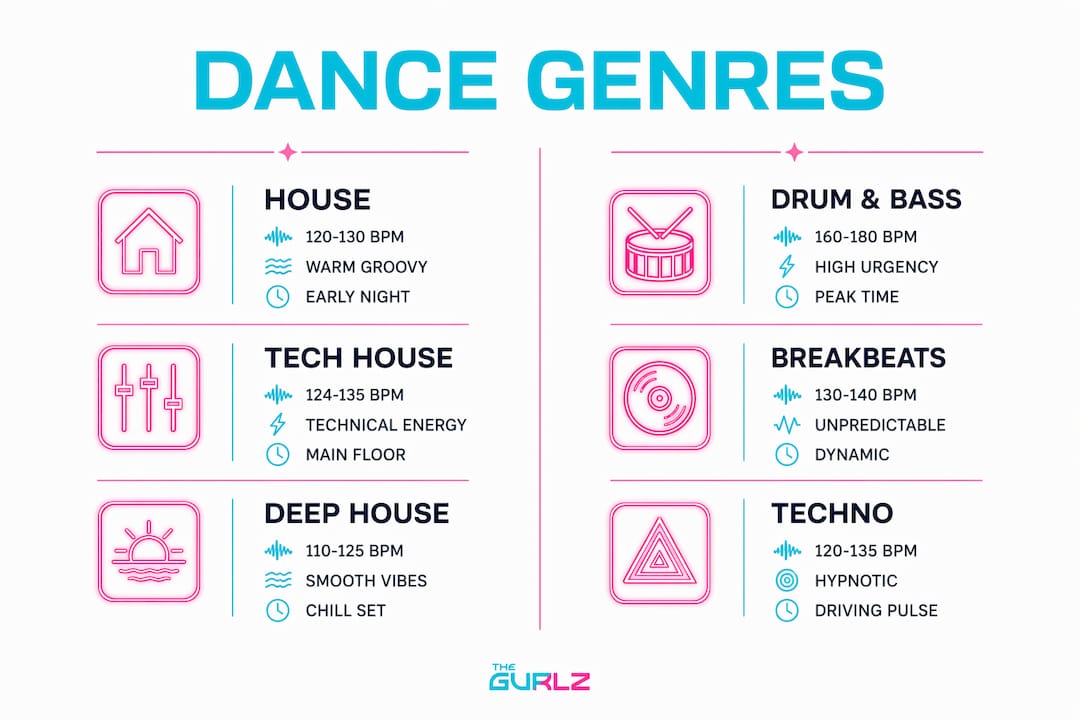
Not every electronic genre is built for the dance floor. The ones that dominate DJ sets share a common trait: they are designed to sustain energy over long periods, not deliver a single emotional peak.
| Genre | Typical BPM | Atmosphere | Dance floor role |
|---|---|---|---|
| House | 120–130 | Warm, groovy, social | Foundation and crowd warm-up |
| Tech house | 124–135 | Driving, hypnotic | Mid-set momentum builder |
| Techno | 130–150 | Dark, relentless, focused | Peak-time intensity |
| Drum and bass | 160–180 | High-energy, bass-heavy | Late-night or specialist sets |
| Breakbeats | 110–140 | Funky, unpredictable | Texture and contrast |
Tech house runs at 124–135 BPM and balances technical depth with accessible energy, making it one of the most effective genres for large festival stages. It works because it never fully alienates a casual listener while still satisfying a trained ear.
Drum and bass operates at a different frequency entirely. The 160–180 BPM range creates a physical urgency that few other genres match. The bass is not just heard. It is felt in the chest. For festival-goers seeking bass-driven dance music, drum and bass and its close relative halftime deliver that physical intensity at a level house music simply does not reach.
Breakbeats sit in an interesting middle ground. The rhythmic patterns are less predictable than four-on-the-floor house, which creates a sense of surprise and texture. THE GURLZ work through drum and bass, breakbeats, halftime, house, and tribal sounds within a single set, treating genre not as a fixed identity but as a color to paint with.
Pro Tip: When choosing dance music for a party, match the genre to the time of night. House and deep house work early. Tech house and drum and bass build toward the peak. Breakbeats add texture anywhere the set needs a shift.
What role does dance-floor DJ music play in festival and party culture?
Dance-floor music is not background sound. It is the architecture of the experience itself.
At a festival, the sound system, the space, and the crowd all shape how the music lands. Producers who make music for large outdoor stages build tracks with wider frequency ranges and more headroom, knowing the bass will travel differently across an open field than inside a club. The music is written for the room before the room exists.
A few things define how dance-floor music functions in these spaces:
- Shared identity. When a drop hits and every person in the crowd reacts at the same moment, individual experience disappears. The music creates a temporary collective identity.
- Physical design. Festival sound systems are built to deliver sub-bass frequencies that a home speaker cannot reproduce. The music is incomplete without that physical dimension.
- Time as a material. A DJ set at a festival can run two to four hours. The music must sustain energy across that entire arc, not just deliver a highlight reel.
- Location as context. Where a set happens changes how it feels. An outdoor set at sunset sounds and feels different from the same music played in a basement club at 2:00 AM.
THE GURLZ built their format around exactly this idea. Their audio-visual DJ sets, starting with Bass & Breakz at Sunset Cliffs and continuing with House in the Wild, treat location as part of the music. The visuals come from the place itself. The edit follows the music closely. Every location-based DJ set they release is a document of a specific moment in a specific place, and that specificity is what makes it land differently than a standard recorded set.
Open-format DJs command a price premium because managing real-time genre navigation, energy arc control, and crowd reading at mixed-demographic events requires a distinct skill set. That skill is what separates a DJ who plays records from one who shapes an experience.
Key Takeaways
Dance-floor DJ music is functional electronic music built around rhythm, phrasing, and energy arcs that serve both the DJ and the crowd simultaneously.
| Point | Details |
|---|---|
| Rhythm over melody | Dance-floor music prioritizes groove and beat over verse-chorus song structures. |
| BPM defines the genre | House runs 120–130 BPM; drum and bass runs 160–180 BPM, shaping the physical experience. |
| Structure serves the DJ | Long intros and outros are built into tracks to enable smooth live mixing transitions. |
| Energy arcs are intentional | DJs build and release tension every 8–32 bars to sustain crowd engagement over hours. |
| Location shapes the music | Festival and outdoor settings change how dance-floor music is produced and experienced. |
Why dance-floor music hits different when the DJ actually understands it
THE GURLZ OFFICIAL perspective
Most people experience dance-floor music as something that happens to them. They walk into a room, the bass hits, and they start moving. What they rarely think about is how deliberate that feeling is.
Every track in a well-built set is a decision. The BPM, the key, the energy level, the texture of the bassline. A DJ who understands the music does not just play records. They read the room, feel where the energy is sitting, and choose the next track to either push it forward or pull it back. That is a skill that takes years to develop, and it is invisible to most people in the crowd.
What Desi and Angelina do with THE GURLZ goes a step further. The music is mixed live, but the visuals are also built around the location and the moment. When the edit follows the music closely, the visual and the sound become one thing. You are not watching a DJ set with a video playing behind it. You are inside a specific place, at a specific time, with the music as the thread that holds it together.
The genres matter too. Drum and bass, breakbeats, halftime, house, tribal. These are not random choices. Each one carries a different physical weight and emotional temperature. Moving between them in a single set requires knowing how each one feels in the body and how to transition without losing the thread. That is what makes a multi-genre set harder and more interesting than a single-genre one.
The best dance-floor music does not ask you to pay attention. It just moves you. The craft is in making that feel effortless.
— THE GURLZ OFFICIAL
THE GURLZ audio-visual DJ sets: music you can watch and feel
THE GURLZ create immersive audio-visual sets that put the principles of dance-floor DJ music into a format you can both hear and see. Desi and Angelina mix live, film the location, and edit the visuals to follow the music closely. The result is something between a DJ set and a film.
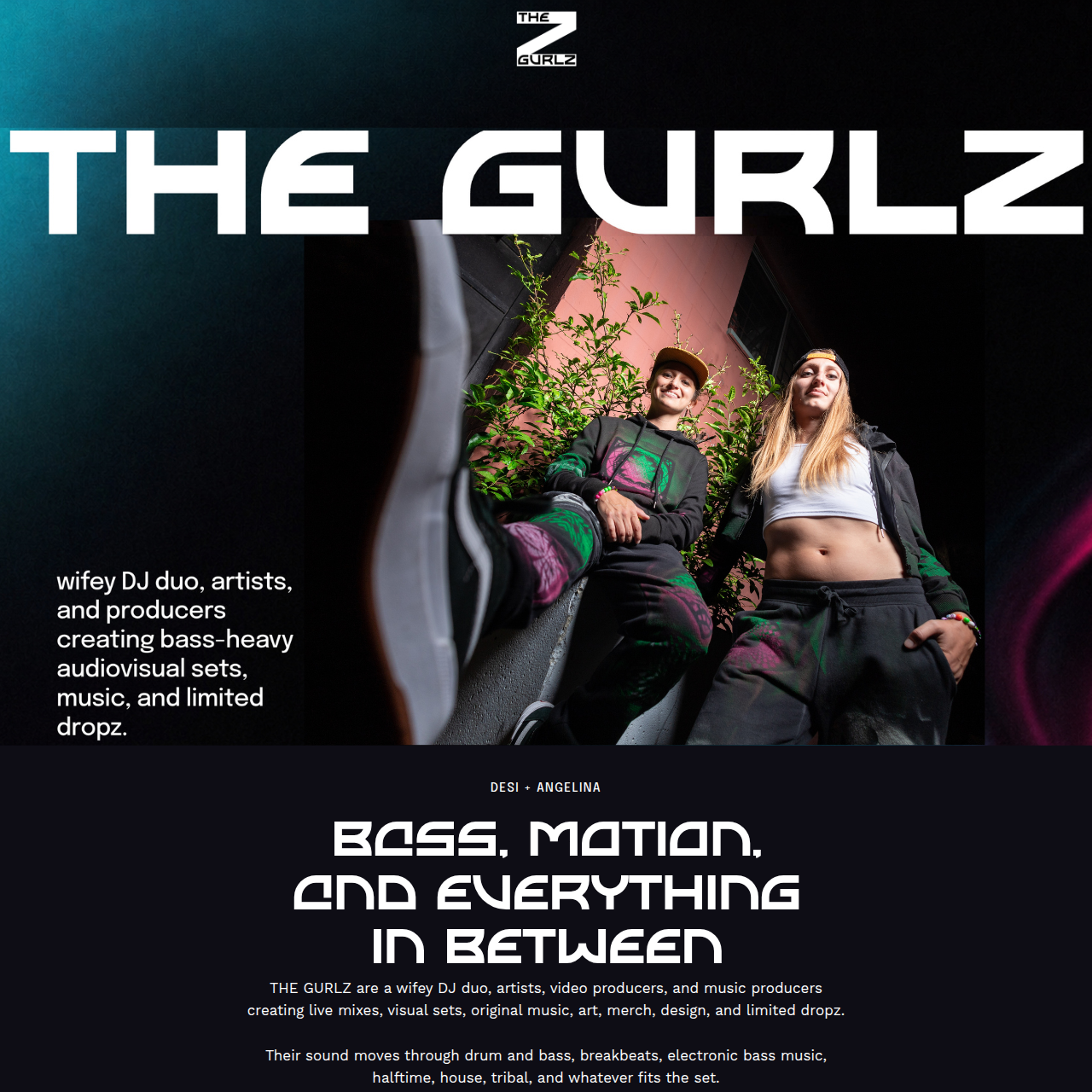
Bass & Breakz at Sunset Cliffs started the format. House in the Wild continued it. Each release is produced, filmed, mixed, and edited entirely by THE GURLZ. Original music is in production. More audio-visual setz are already in motion. If you want to understand what best audiovisual DJ sets look and feel like, this is the place to start.
IG: @thegurlzmusic, main social for behind-the-scenes and exclusive content
TikTok: @thegurlzofficial
Youtube: @TheGurlzOfficial
SoundCloud: https://soundcloud.com/thegurlz
www.thegurlzofficial.com
FAQ
What is dance-floor DJ music?
Dance-floor DJ music is electronically produced music built around steady rhythmic patterns, predictable phrasing, and energy arcs designed to sustain continuous movement at parties and festivals. It prioritizes groove and rhythm over traditional song structures like verse and chorus.
What BPM is used in dance-floor DJ music?
BPM varies by genre. House music runs at 120–130 BPM, tech house sits at 124–135 BPM, and drum and bass reaches 160–180 BPM. Understanding BPM in dance music helps both DJs and listeners understand why different genres feel physically different.
Why do dance-floor tracks have long intros and outros?
Long intros and outros are a deliberate production choice that gives DJs a clean window to blend tracks without disrupting the crowd’s energy. Tracks without these features require advanced mixing techniques like looping to transition smoothly.
What are the most popular dance music genres for DJ sets?
House, tech house, techno, drum and bass, and breakbeats are the most widely used genres in DJ sets. Each carries a different energy level and physical weight, and skilled DJs blend them to shape the crowd experience across an entire night.
How do DJs keep a crowd engaged for hours?
DJs manage energy arcs by building and releasing tension through track selection, BPM shifts, and genre changes. The goal is a shared collective experience where the crowd moves as one, not just a sequence of individual songs.
Recommended
- The Role of BPM in Dance Music: A Dancer’s Guide – ☀︎THE GURLZ ☽ – WIFEY DJ DUO / ARTISTS / PRODUCERS
- Bass-Driven Dance Music: What Festival-Goers Need to Know – ☀︎THE GURLZ ☽ – WIFEY DJ DUO / ARTISTS / PRODUCERS
- What Is Peak-Time DJ Music? A Festival Guide – ☀︎THE GURLZ ☽ – WIFEY DJ DUO / ARTISTS / PRODUCERS
- Bass Music Tempos for Dancers: The Complete BPM Guide – ☀︎THE GURLZ ☽ – WIFEY DJ DUO / ARTISTS / PRODUCERS


