
TL;DR:
- Rolling bass in DnB is a continuous, hypnotic groove that sustains energy without dramatic drops. It relies on Reese bass synthesis and subtle rhythmic modulation to keep dancers locked in and engaged over long sets.
Rolling bass in DnB is defined as a continuous, hypnotic bassline style that drives forward momentum without relying on dramatic drops or tension-and-release structures. Producers build it around relentless rhythmic groove, typically at 172–176 BPM, where the bass never fully stops moving. The result is a trance-like, physical experience that keeps dancers locked in for extended periods. This is not just a sound patch or a preset. Rolling bass is a rhythmic philosophy, and understanding it changes how you listen, produce, and perform DnB.
What is rolling bass in DnB and why does it matter?
Rolling bass is a continuous, hypnotic bassline that prioritizes relentless groove over dramatic drops. That distinction matters more than it sounds. Most electronic music builds toward a moment of release. Rollers reject that structure entirely. The energy stays constant, the bass keeps moving, and the crowd stays in a sustained physical state rather than waiting for the next explosion.
The term “roller” is the recognized industry label for this style. You will hear producers and DJs use it interchangeably with “rolling bass” to describe tracks built around this continuous groove approach. Knowing both terms helps you search for the right music, tutorials, and references.
Rolling bass spans liquid, deep, and minimal DnB subgenres. Artists like Calibre, DLR, and Alix Perez built careers on this approach. Their tracks share one defining quality: the groove is the event. There is no buildup to a payoff. The payoff is the groove itself, sustained across the full length of the track.
How does rolling bass shape dancefloor energy?
Rolling bass anchors the rhythm in a way that fast DnB percussion alone cannot. Percussion running at 160–180 BPM can feel thin or chaotic without a bass element grounding it. The rolling bassline provides the weight that makes the music feel physical rather than frantic.

The groove works through interplay between the bass, silence, and drums. This is the “less is more” principle in practice. The bass does not fill every gap. It moves with the drum pattern, breathes with the ghost notes, and creates a hypnotic pulse through repetition and subtle variation. That pulse is what locks dancers in for 10, 20, or 30 minutes without fatigue.
Key characteristics of rolling bass dancefloor function:
- Sustained energy. The groove runs continuously, avoiding the crowd reset that happens after a typical drop.
- Physical weight. Bass movement anchors fast percussion and keeps the music grounded in the body.
- Trance-like effect. Repetition with subtle modulation creates a hypnotic state that rewards endurance on the floor.
- Crowd endurance. Rollers are built for long DJ sets. The energy does not spike and crash. It holds.
Pro Tip: When listening to a roller, focus on what the bass is NOT doing. The spaces between notes are as important as the notes themselves. That restraint is what creates the groove.
What production techniques define rolling bass?
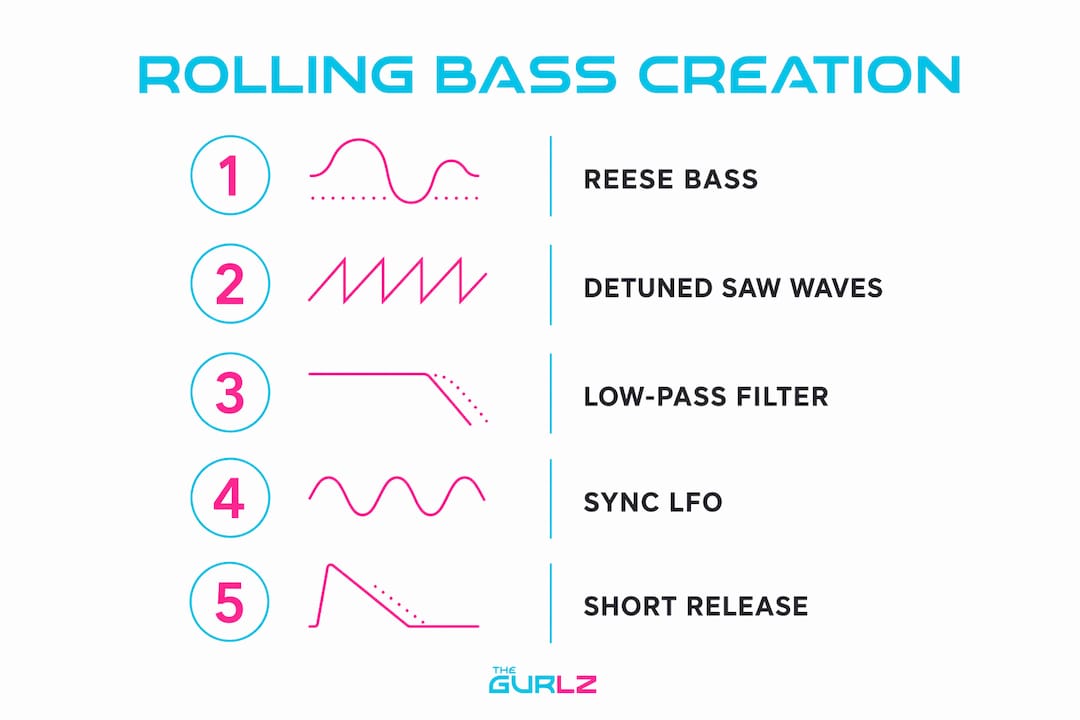
The Reese bass is the foundation of most rolling basslines. Two saw waves detuned by 7–12 cents with multiple unison voices create the characteristic wide, moving sound. The detuning produces natural movement between the oscillators, which is what gives the bass its living, breathing quality. No modulation required to get that base movement started.
From there, the low-pass filter does the heavy lifting. A filter cutoff between 600Hz and 1.2 kHz, modulated by an LFO synced to 1/8 or 1/16 notes, creates the rhythmic pulsing that defines the rolling effect. The LFO depth stays moderate. The goal is subtle pulsing that aligns with the drum groove, not dramatic filter sweeps that draw attention to themselves.
Step-by-step production approach
- Build the oscillator layer. Use two saw waves. Detune one by 7–12 cents. Add unison voices for width. This creates the Reese bass foundation.
- Set the filter. Apply a low-pass filter with cutoff around 600Hz–1.2 kHz. Keep resonance low to avoid harshness at high volumes.
- Sync the LFO. Modulate the filter cutoff with an LFO synced to 1/8 or 1/16 notes. Match the LFO rate to your drum groove.
- Shape the amplitude envelope. Use a fast attack and moderate release. This keeps each bass note clear and defined at 172–176 BPM.
- Align with ghost notes. Program the bass pattern to interact with drum ghost notes. The bass and drums should feel like one organism.
- Arrange gradually. Layer elements in and out over 16–32 bar phrases. Avoid dramatic drops. Let the groove evolve slowly.
| Parameter | Setting | Purpose |
|---|---|---|
| Oscillator type | Dual saw waves | Creates Reese bass foundation |
| Detune amount | 7–12 cents | Produces natural movement between voices |
| Filter cutoff | 600Hz–1.2 kHz | Controls brightness and weight |
| LFO sync | 1/8 or 1/16 notes | Rhythmic pulsing aligned to drums |
| Amplitude attack | Fast | Keeps notes defined at high BPM |
| Amplitude release | Moderate | Avoids muddiness between notes |
Pro Tip: Long release times are the most common beginner mistake in roller production. At 172–176 BPM, a release that is too long causes bass notes to blur together. Keep it moderate and let the silence between notes do the work.
How does rolling bass fit across DnB subgenres?
Rolling bass is a stylistic approach, not a subgenre. That distinction is worth stating clearly because producers and listeners often confuse the two. Rollers appear across liquid, deep, and minimal DnB, each applying the same groove philosophy with different tonal and emotional qualities.
Liquid DnB uses rolling bass with melodic, atmospheric elements layered above the groove. The bass stays hypnotic while chords and pads create emotional depth. Deep DnB strips the arrangement further, letting the bass and drums carry almost everything. Minimal DnB takes that approach to its logical conclusion, where the rolling bassline and a sparse drum pattern are the entire track.
| Subgenre | Rolling bass character | Arrangement focus |
|---|---|---|
| Liquid DnB | Warm, melodic, smooth | Melody and atmosphere above the groove |
| Deep DnB | Dark, textured, sustained | Bass and drums as primary elements |
| Minimal DnB | Sparse, hypnotic, stripped | Groove alone carries the track |
| Neurofunk | Aggressive, modulated, complex | Sound design over sustained groove |
| Jump-up | Punchy, rhythmic, drop-focused | Tension and release structures |
Neurofunk and jump-up use basslines, but they do not qualify as rollers. Neurofunk prioritizes complex sound design and aggressive modulation. Jump-up builds toward drops. Both approaches serve different crowd moments. Rollers serve the long game, the sustained energy that carries a set across an hour without a single dramatic reset.
Calibre is the clearest reference point for understanding what rolling bass sounds like in practice. His tracks demonstrate how sustained energy over explosive bursts creates a deeper crowd connection than any drop can achieve.
What practical applications does rolling bass have for musicians and DJs?
Producers who understand rolling bass build tracks with better club impact. The key is gradual introduction and removal of elements over many bars, keeping the bass and drums running continuously while other elements breathe in and out. This creates variation without breaking the groove. The crowd stays engaged because the energy never fully releases.
For DJs, rolling bass tracks are tools for extended mixing. Double-dropping two rollers creates a third rhythm from the combination of both basslines. That technique only works cleanly when both tracks share consistent energy and minimal frequency clashes. Rollers are built for exactly that kind of layering.
Practical applications for musicians and DJs:
- Club production. Build basslines that loop with purpose. Automate filter cutoff and LFO depth gradually over 16–32 bars to maintain interest without dropping the groove.
- Double-dropping. Select two rollers with complementary bass registers. Drop them simultaneously to create a new combined rhythm. The consistent energy of rollers makes this technique reliable live.
- Seamless transitions. Rolling bass tracks blend cleanly because their energy stays constant. Use them to move between sections of a set without crowd reset moments.
- Frequency management. When mixing two rollers live, check that their bass frequencies do not stack in the same register. Complementary bass registers create depth. Stacked registers create mud.
- Automation for interest. In production, automate subtle changes every 8–16 bars. Bring in a hi-hat layer, shift the filter cutoff slightly, or add a pad. The groove holds while the texture shifts.
Pro Tip: When building a set around rollers, use BPM consistency as your anchor. Staying within the 172–176 BPM range lets you mix longer without tempo drift pulling the crowd out of the groove.
THE GURLZ on rolling bass and what it actually does to a crowd
Rolling bass does something that most music cannot. It removes the waiting. Crowds at a typical set spend half their energy anticipating the drop. With rollers, there is no drop to wait for. The music is already there, already moving, already physical. That changes how people dance and how long they stay on the floor.
Desi and Angelina have mixed rolling bass tracks in sets filmed at locations like Sunset Cliffs, and the crowd response is different from drop-heavy sets. The energy builds slowly and holds. People do not surge and retreat. They settle into the groove and stay. That sustained engagement is what makes rollers so valuable in a live audio-visual context.
The visual side of THE GURLZ sets responds to that sustained energy directly. When the bass rolls without breaking, the edit can follow the texture of the music rather than cutting to a drop moment. The visuals breathe with the groove. Color, movement, and texture shift gradually, the same way the arrangement does. That alignment between sound and image is only possible when the music itself holds its energy consistently.
The lesson from performing with rollers is this: restraint is the technique. The bass does not need to do everything. The groove does the work when you let it.
— THE GURLZ OFFICIAL
THE GURLZ audio-visual sets: rolling bass in motion
THE GURLZ build their sets around bass music that moves. Rolling bass is central to that approach because it holds the energy across the full length of a set without resetting the crowd.
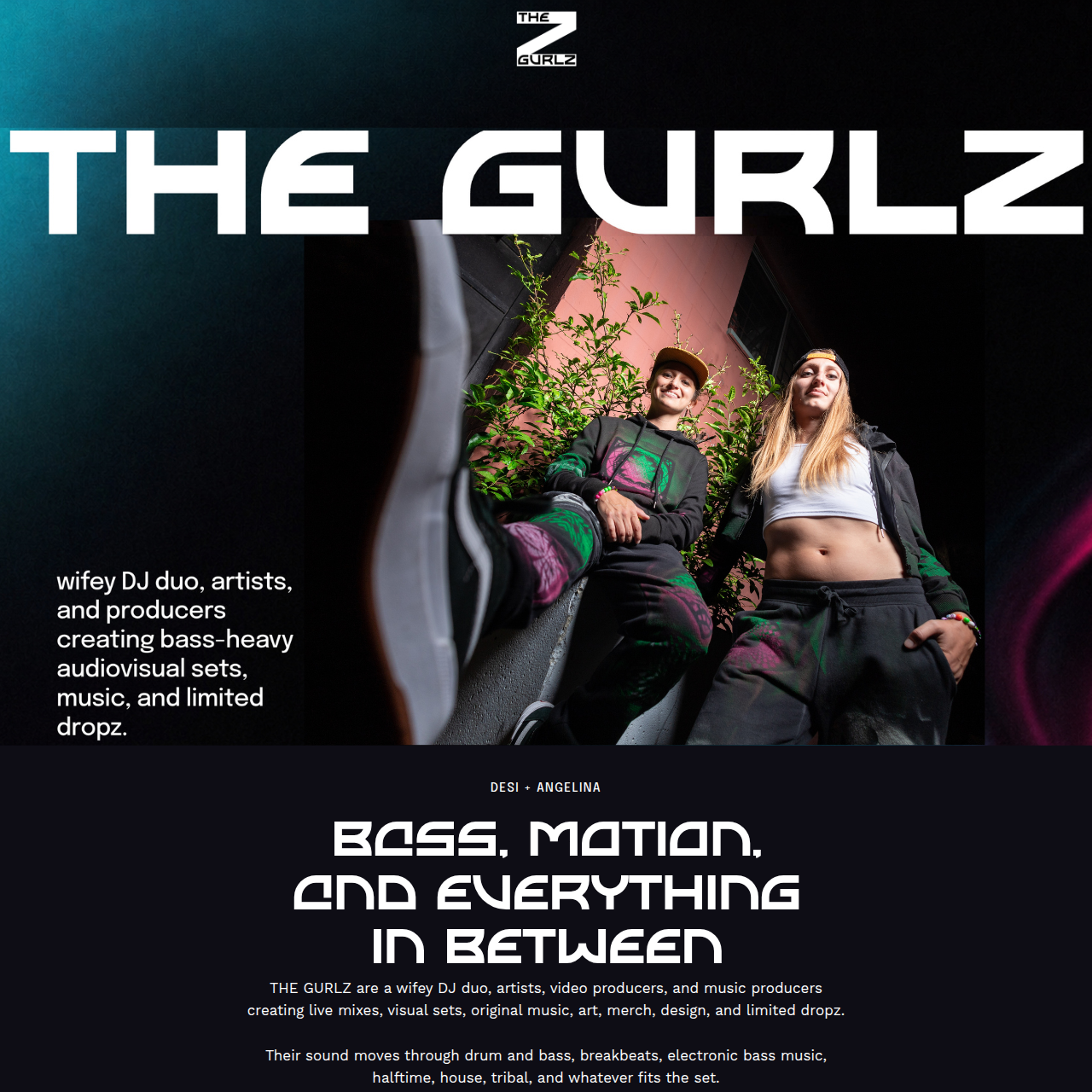
Bass & Breakz at Sunset Cliffs was where THE GURLZ first put this format on film. House in the Wild continued it. Each set is mixed live, filmed on location, and edited to follow the music closely. The bass drives the visuals as much as it drives the crowd. Watch the full audio-visual sets to hear rolling bass working in a real live mix, or explore location-based DJ sets to see how the format takes shape in different environments. Original music from THE GURLZ is coming soon.
Key Takeaways
Rolling bass in DnB is a rhythmic philosophy built on continuous groove, Reese bass synthesis, and gradual arrangement that sustains dancefloor energy without dramatic drops.
| Point | Details |
|---|---|
| Rolling bass definition | A continuous, hypnotic bassline style that prioritizes sustained groove over drops. |
| Core production setup | Dual detuned saw waves, low-pass filter at 600Hz–1.2 kHz, LFO synced to 1/8 or 1/16 notes. |
| Subgenre presence | Rollers appear across liquid, deep, and minimal DnB as a stylistic approach, not a subgenre. |
| DJ application | Double-dropping two rollers creates a third combined rhythm suited for long-duration mixing. |
| Common production mistake | Release times that are too long blur bass notes at 172–176 BPM. Keep the release moderate. |
FAQ
What is rolling bass in DnB?
Rolling bass is a continuous, hypnotic bassline style in drum and bass that drives forward groove without dramatic drops. It runs at 172–176 BPM and creates a trance-like, physical experience for dancers.
What does a bass drop mean in DnB?
A bass drop is the moment when tension releases and the full bassline hits after a breakdown or buildup. Rolling bass tracks deliberately avoid this structure, keeping energy constant instead.
How do you create rolling bass in DnB?
Start with two detuned saw waves to build a Reese bass, apply a low-pass filter between 600Hz and 1.2 kHz, and sync an LFO to 1/8 or 1/16 notes to create rhythmic pulsing aligned with the drum groove.
What makes rolling bass unique compared to other DnB styles?
Rollers are considered the purest form of DnB because they rely entirely on sustained groove rather than sound design gimmicks or drop structures. The groove lives in the interaction between bass, silence, and drums.
Which artists are known for rolling bass in DnB?
Calibre, DLR, and Alix Perez are the most recognized artists in the roller style, each building their sound around sustained energy and hypnotic groove rather than explosive moments.
IG: @thegurlzmusic, main social for behind-the-scenes and exclusive content
TikTok: @thegurlzofficial
Youtube: @TheGurlzOfficial
SoundCloud: https://soundcloud.com/thegurlz
www.thegurlzofficial.com
Recommended
- How to Find Original Bass Electronic Music – ☀︎THE GURLZ ☽ – WIFEY DJ DUO / ARTISTS / PRODUCERS
- Why DnB Is Popular with Female Dancers in 2026 – ☀︎THE GURLZ ☽ – WIFEY DJ DUO / ARTISTS / PRODUCERS
- Bass Music Tempos for Dancers: The Complete BPM Guide – ☀︎THE GURLZ ☽ – WIFEY DJ DUO / ARTISTS / PRODUCERS
- Women DJs Breaking Bass Music Barriers: Who to Know – ☀︎THE GURLZ ☽ – WIFEY DJ DUO / ARTISTS / PRODUCERS


