
TL;DR:
- Breakbeats are syncopated drum patterns that break away from the four-on-the-floor rhythm in dance music. They create cognitive engagement, physical tension, and inspire genre innovation through their incomplete structure and micro-timing variations.
Breakbeats are defined as syncopated drum patterns that deliberately break away from the four-on-the-floor grid dominating most dance music. That single structural choice changes everything. Why breakbeats are unique in dance music comes down to three things: rhythmic incompleteness, cognitive engagement, and a production history that reshaped entire genres. The Amen Break, a 5.2-second drum solo, became the rhythmic foundation for jungle, drum and bass, and hip-hop. The corpus of breakbeat releases totals 18,196 items, with the largest concentration of 7,421 items occurring in the 1990s. That volume reflects a movement, not a trend.
Why are breakbeats rhythmically distinct from other dance music beats?
Breakbeats depart from the steady kick-on-every-beat pattern that defines techno, house, and most commercial dance music. The four-on-the-floor beat aligns with the human heartbeat at rest. Breakbeats do not. They land on unexpected positions, creating tension before resolving it.
The technical term for this is syncopation. Syncopation places rhythmic emphasis on metrically weak positions, the “and” counts between the main beats. Breakbeat tracks typically run 130–150 BPM, while drum and bass pushes 160–180 BPM. At those speeds, syncopated hits create micro-anticipation cycles that pull the body forward before the beat fully lands.
Three structural elements separate breakbeats from straight 4/4 patterns:
- Syncopated snare placement. The snare lands off the two and four, creating rhythmic surprise.
- Ghost notes. Quiet, almost inaudible drum hits between main beats that add swing and organic feel.
- Micro-timing deviations. Hits pulled slightly ahead or behind the grid create tension and quick resolution.
Unlike techno’s perfect grid, breakbeats use these pulled-ahead or delayed hits for dynamic tension. That tension is not random. It is purposeful, and it directly stimulates the sensorimotor system.
Pro Tip: When producing breakbeats, resist the urge to fully quantize your drum hits. A few milliseconds of timing variation on the snare and hi-hat preserves the human swing that makes the groove feel alive.
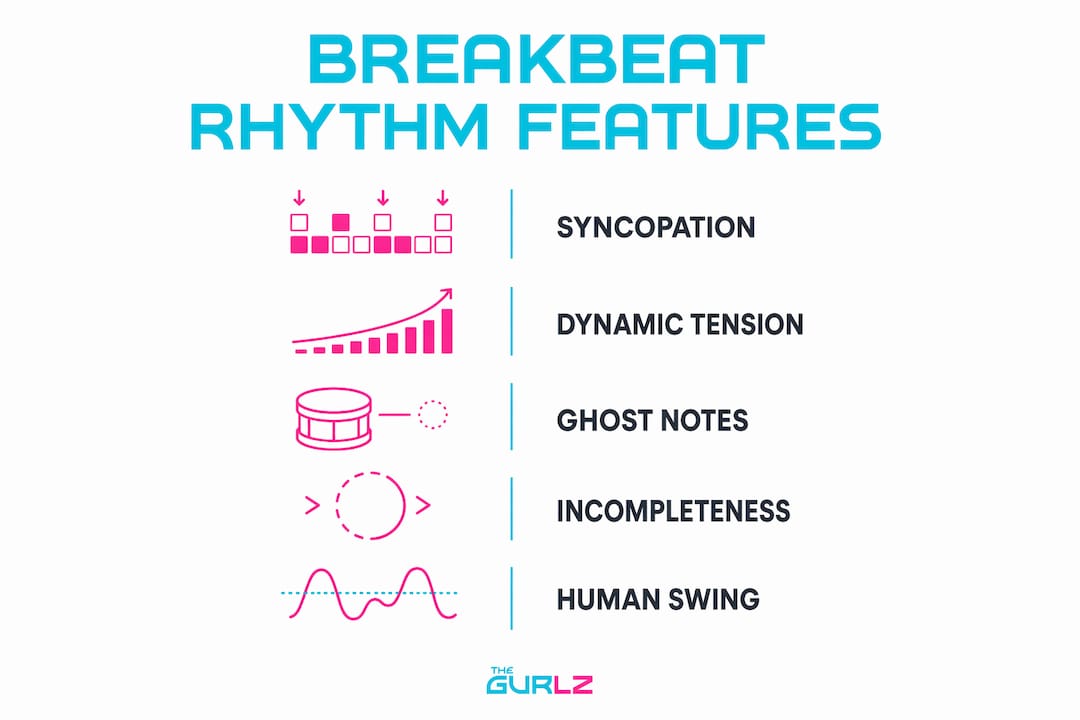
The rhythmic “incompleteness” of a breakbeat is also a feature, not a flaw. The pattern feels like it is always about to resolve into something bigger. That feeling keeps dancers moving and producers reaching for new ways to complete the phrase.
How did the Amen Break shape modern dance music?
The history of breakbeats begins in the Bronx. DJ Kool Herc pioneered the technique of looping drum breaks in the early 1970s, isolating the percussion-only sections of funk and soul records. That practice became the foundation of hip-hop and, eventually, every genre that followed.
The Amen Break comes from a 1969 recording by The Winstons. It is a 5.2-second drum solo. By the late 1980s and early 1990s, that clip had traveled from New York to London, where rave producers began accelerating it far beyond its original tempo.
The key steps in that evolution:
- Sampling culture emerges (1970s–1980s). Hip-hop producers loop drum breaks manually using two turntables.
- Hardware samplers arrive (late 1980s). The Akai S950 sampler allowed producers to pitch-shift and time-stretch breaks digitally.
- Pitch-shifting creates new sounds (early 1990s). The Akai S950 altered spectral balance through pitch-shifting, producing the metallic snare crack that defines jungle.
- Jungle and drum and bass accelerate the break (1992–1995). Producers pushed the Amen Break to 160+ BPM, creating a new genre almost by accident.
- The break goes global. Drum and bass spread from London to the world, carrying the Amen Break with it into big beat, neurofunk, and liquid DnB.
The original Amen Break is a 5.2-second drum solo, often accelerated to 160+ BPM in rave music, altering frequency interactions significantly. That acceleration did not just change the tempo. It changed the texture, the mood, and the entire emotional register of the music.
The Amen Break appears in thousands of commercial recordings across jungle, drum and bass, hip-hop, and advertising. Its longevity comes from the fact that it is not a finished loop. It is raw material. Every producer who uses it finishes it differently.
Why do breakbeats engage dancers more than steady beats?
Breakbeats engage dancers cognitively in a way that four-on-the-floor beats do not. A steady kick drum aligns with cardiovascular rhythm and creates a predictable physical response. Breakbeats create micro-anticipation instead. The brain predicts where the next hit will land, gets it slightly wrong, and releases a small reward signal when the beat resolves. That cycle repeats constantly.
“Breakbeats function as a cognitive tool by emphasizing metrically weak positions, creating micro-anticipation and resolution cycles that physically engage dancers more than the predictable four-on-the-floor beat.”
This is sometimes called “predictive coding” in music perception research. The brain builds a rhythmic model and updates it in real time. Breakbeats force more frequent updates, which means more cognitive engagement and more physical response.
The perceived chaos in breakbeat tracks is an illusion. Repetitive core loops provide stability that allows layering of intense textures without overwhelming listeners. The chaos is safe. The body can move freely because the underlying structure holds.
Successful breakbeat tracks maintain predictable repetition cycles while layering dense, high-energy textures on top. That combination sustains energy on a dance floor for extended periods without fatigue.
Pro Tip: When building a breakbeat set, anchor your transitions on the core loop, not the top-layer textures. Dancers feel the anchor even when they cannot consciously identify it. Keep that foundation solid and the complexity above it can go anywhere.
The importance of ghost notes cannot be overstated here. Removing ghost notes reduces the humanized dynamic that energizes breakbeat tracks. Those quiet hits between the main beats are what separates a groove from a drum machine pattern.
How do breakbeats serve as a framework for genre innovation?
Breakbeats are inherently incomplete rhythmic statements, inviting producers to complete and reshape them through slicing and resequencing. That incompleteness is the source of their creative power. A four-on-the-floor kick pattern is finished the moment it loops. A breakbeat is always asking what comes next.
Modern production techniques have expanded what producers can do with a break:
- Slicing. Chopping the break into individual hits and reordering them to create new rhythmic phrases.
- Resequencing. Rebuilding the break in a different order to shift the rhythmic emphasis.
- Layering. Adding new drum sounds on top of or underneath the original break to thicken the texture.
- Pitch manipulation. Shifting individual hits up or down to create melodic or tonal variation within the rhythm.
The genres that breakbeats have directly shaped span a wide range:
| Genre | Breakbeat role | Typical BPM |
|---|---|---|
| Hip-hop | Foundation of the groove | 80–100 |
| Jungle | Accelerated Amen Break, chopped and layered | 160–170 |
| Drum and bass | Resequenced breaks over sub-bass | 160–180 |
| Big beat | Slower, heavier breaks with rock influence | 120–140 |
| Breakbeat house | Syncopated breaks replacing four-on-the-floor | 125–135 |
Breakbeat is a “way of hearing music,” distinct from a finished loop, offering an open-ended foundation that resists obsolescence as every generation reinterprets it. That is why the form keeps producing new genres. It is not a sound. It is a method.
THE GURLZ work directly inside this tradition. Their sets move through drum and bass, breakbeats, halftime, and house, mixing live while original visuals from the location play alongside the music. The Bass & Breakz at Sunset Cliffs set brought this format to life outdoors, with the break as the rhythmic anchor and the visual world built around it. Every set they produce pushes the format further.
Key Takeaways
Breakbeats stand out in dance music because their syncopated, incomplete structure creates cognitive engagement, physical response, and endless creative reinterpretation that no steady four-on-the-floor pattern can replicate.
| Point | Details |
|---|---|
| Rhythmic incompleteness | Breakbeats are open-ended patterns that invite producers to complete and reshape them every generation. |
| Cognitive engagement | Syncopated hits create micro-anticipation cycles that physically pull dancers in more than steady beats do. |
| Ghost notes matter | Preserving ghost notes maintains the human swing that gives breakbeat tracks their organic groove. |
| Historical depth | The Amen Break traveled from a 1969 recording to 18,196 documented releases across multiple genres. |
| Genre engine | Breakbeats directly shaped jungle, drum and bass, hip-hop, big beat, and breakbeat house production. |
THE GURLZ on what breakbeats actually do to a room
Most people talk about breakbeats as a genre. Desi and Angelina of THE GURLZ experience them as a physical force.
When you drop a syncopated break after a stretch of four-on-the-floor, the room shifts. Not metaphorically. People’s bodies change. The predictable pulse gets interrupted, and suddenly everyone is listening with their whole body, not just their feet. That moment of rhythmic surprise is where the real connection happens.
THE GURLZ built Bass & Breakz at Sunset Cliffs around that exact feeling. The break was not decoration. It was the architecture. The visuals followed the rhythm, the edits landed on the hits, and the location became part of the texture. That is what breakbeats make possible. They leave space. Space for visuals, space for bass, space for the audience to bring something of their own.
The advice for artists inspired by breakbeat rhythms is simple: do not over-quantize, do not over-explain, and do not resolve everything. The tension is the point. Let the break stay incomplete a little longer than feels comfortable. That discomfort is where the groove lives.
Breakbeats are not a trend from the 1990s. They are a way of hearing rhythm that keeps producing new music because it never fully closes. Every set THE GURLZ plays is proof of that. The break keeps opening.
— THE GURLZ OFFICIAL
THE GURLZ: bass, breaks, and visuals built for the dance floor
THE GURLZ are Desi and Angelina, a wifey DJ duo and production team creating immersive audio-visual sets where the music and visuals are built together from the ground up.
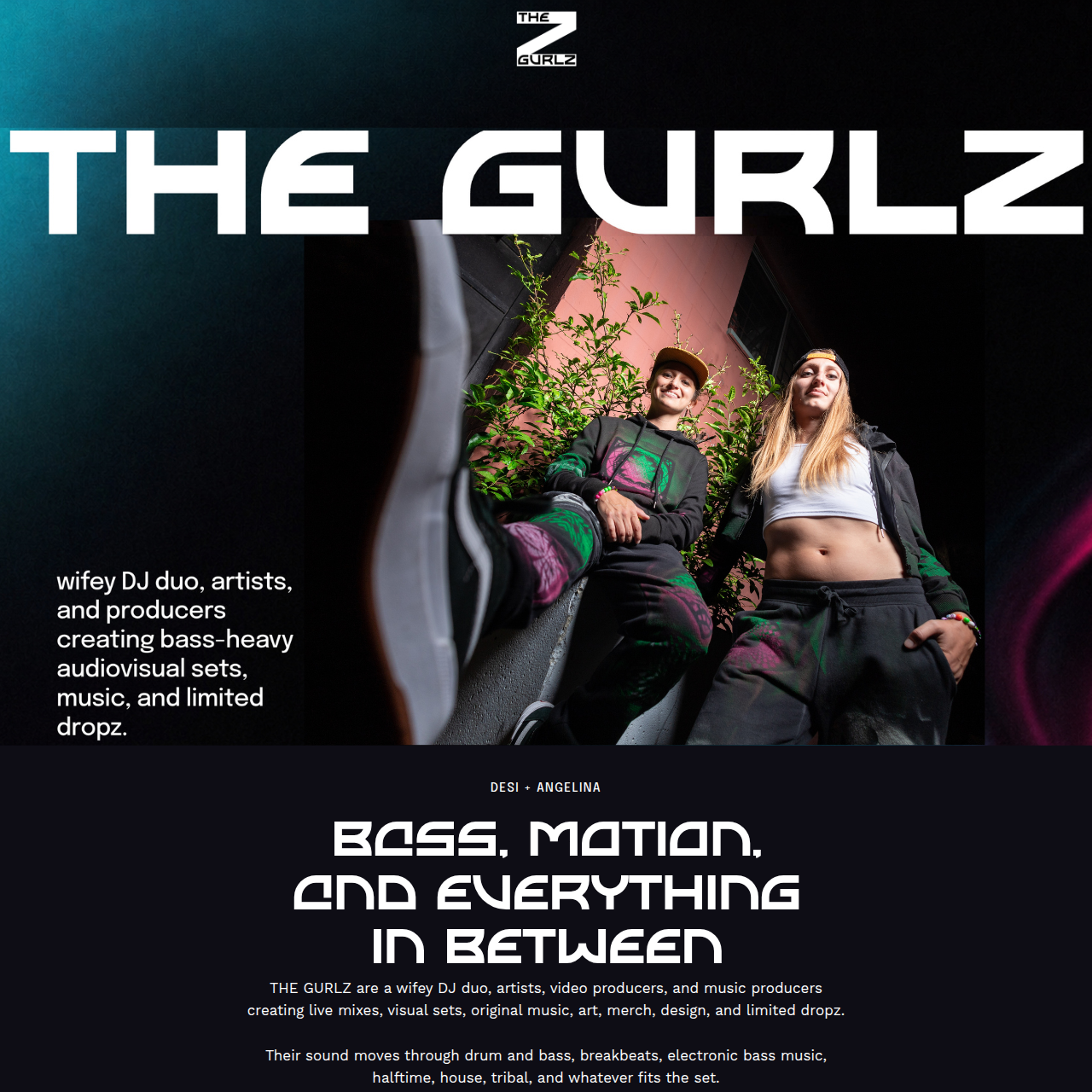
Their sets move through drum and bass, breakbeats, halftime, house, and tribal. Every mix is live. Every visual comes from the location, the light, and the world around the set. Bass & Breakz at Sunset Cliffs started the format. House in the Wild continued it. Original music is in production now.
If you want to hear what breakbeats sound like when they are mixed with intention and filmed with the same care, explore THE GURLZ and see what the format looks like in motion.
FAQ
What makes breakbeats different from four-on-the-floor beats?
Breakbeats place drum hits on syncopated, off-grid positions instead of the steady kick-on-every-beat pattern of four-on-the-floor. That rhythmic displacement creates tension and micro-anticipation that engages dancers physically and cognitively.
Why are breakbeats good for dancing?
Breakbeats create micro-anticipation and resolution cycles by emphasizing metrically weak positions, which stimulates the sensorimotor system and pulls the body into movement more actively than predictable steady beats do.
What is the Amen Break and why does it matter?
The Amen Break is a 5.2-second drum solo from a 1969 recording that became the rhythmic foundation of jungle, drum and bass, and hip-hop. It has been identified in thousands of commercial recordings and remains the most sampled drum break in music history.
What BPM range do breakbeats typically use?
Breakbeat tracks typically run 130–150 BPM, while drum and bass uses 160–180 BPM. The tempo range directly affects how the syncopated patterns interact with the body and the dance floor.
How do producers keep breakbeats sounding organic at high tempos?
Producers preserve ghost notes, the quiet hits between main beats, to maintain human swing and dynamic variation. Over-quantizing removes those subtle timing differences and flattens the groove.
IG: @thegurlzmusic, main social for behind-the-scenes and exclusive content
TikTok: @thegurlzofficial
Youtube: @TheGurlzOfficial
SoundCloud: https://soundcloud.com/thegurlz
www.thegurlzofficial.com
Recommended
- Why DnB Is Popular with Female Dancers in 2026 – ☀︎THE GURLZ ☽ – WIFEY DJ DUO / ARTISTS / PRODUCERS
- How to Find Original Bass Electronic Music – ☀︎THE GURLZ ☽ – WIFEY DJ DUO / ARTISTS / PRODUCERS
- Women DJs Breaking Bass Music Barriers: Who to Know – ☀︎THE GURLZ ☽ – WIFEY DJ DUO / ARTISTS / PRODUCERS
- Bass Music Tempos for Dancers: The Complete BPM Guide – ☀︎THE GURLZ ☽ – WIFEY DJ DUO / ARTISTS / PRODUCERS


